AI search · Analytics · Measurement
Does AI drive direct traffic, and is that why your "Direct" numbers keep climbing? It's one of the most popular theories in marketing right now: people see a brand in ChatGPT or Google's AI answers, then type the website in later, so AI's real impact is "hiding" in Direct traffic. New research suggests the story is not that simple. When one analyst dug into the data, much of the rising AI direct traffic turned out to be bots.
That doesn't mean AI search doesn't matter. It means a growing Direct line in Google Analytics is not, on its own, proof that your AI strategy is working.
The takeaway: Don't use Direct traffic as your scoreboard for AI. Track three things instead: whether AI tools mention you, whether AI tools send you visitors you can actually see, and whether new leads and customers say they found you through AI.
First, what is "Direct" traffic?
Google Analytics 4 (GA4), Google's free website analytics tool, sorts every visit into a "channel" based on where the visitor came from. Organic Search, Paid Search, Email and Social are all channels.
Direct is the bucket for visits that arrive with no clear source. GA4 describes it as people reaching your site through a saved link or by typing your web address. In practice, it also picks up many visits where the source information simply gets lost, which is why it's often called a "catch-all."
That catch-all nature is exactly why the AI theory took off. If someone reads about your business in an AI answer, then opens a new tab and types your name into the address bar, that visit lands in Direct. No link was clicked, so AI gets no credit.
The theory is reasonable. The question is whether the data actually shows it.
Does AI drive direct traffic? What the new GA4 data found
A recent analysis of 12 GA4 accounts set out to find exactly this kind of hidden AI traffic. The sites leaned toward business-to-business (B2B) companies, and all but two targeted the US.
To give the theory its best chance, the study left out pages people normally type in or bookmark, such as homepages, pricing pages, login pages, account dashboards and checkout pages. What remained were deeper pages, like long blog posts, that few people would ever type from memory.
At first, the results looked exciting:
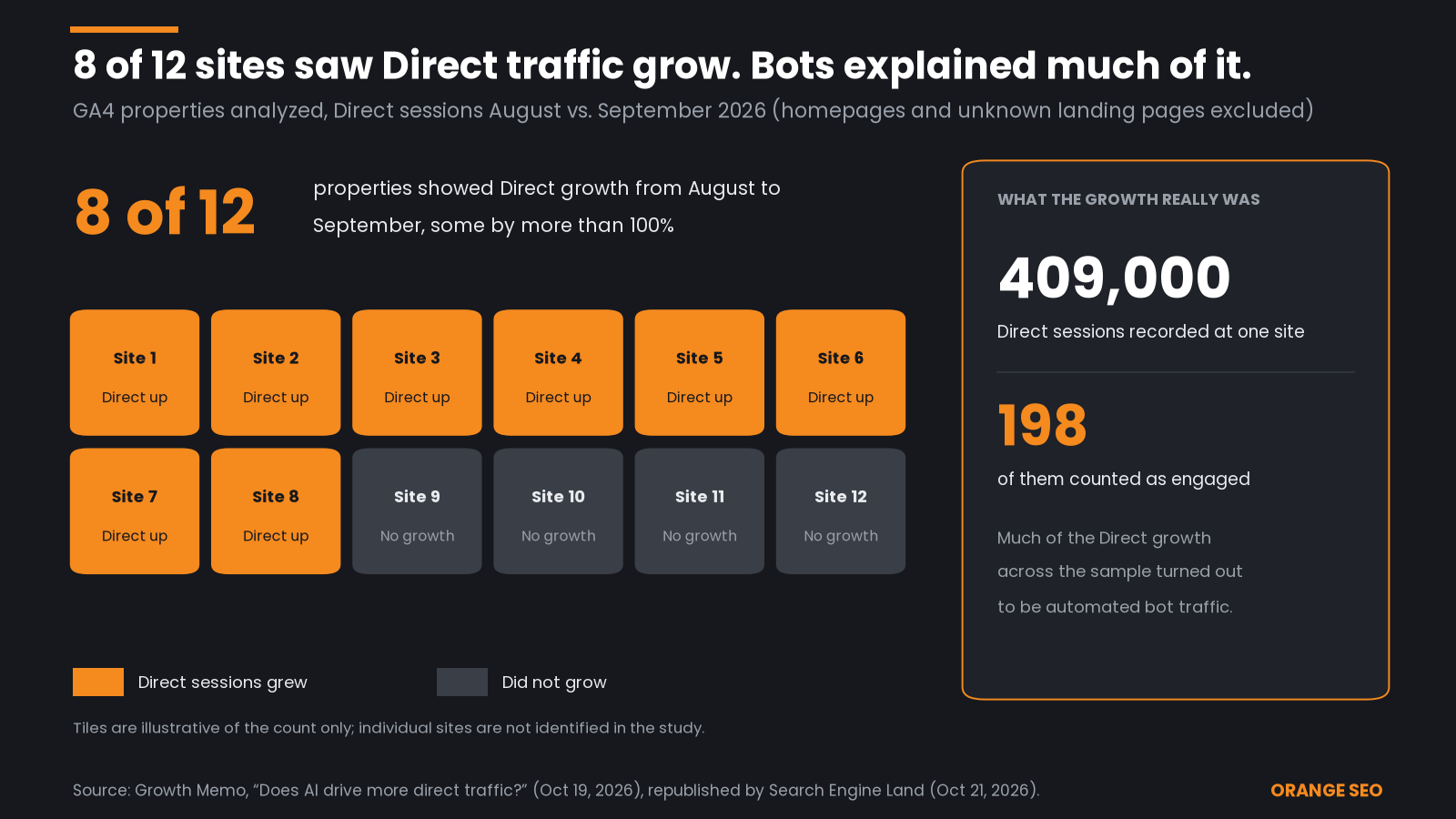
- 8 of the 12 sites showed Direct traffic growth from August to September 2026, some by more than 100%.
- But on closer inspection, much of that growth turned out to be automated bot traffic, not people.
- At one website, GA4 recorded 409,000 Direct sessions, and only 198 of them counted as engaged.
Source: Growth Memo, “Does AI drive more direct traffic?” (Oct 19, 2026), republished by Search Engine Land.
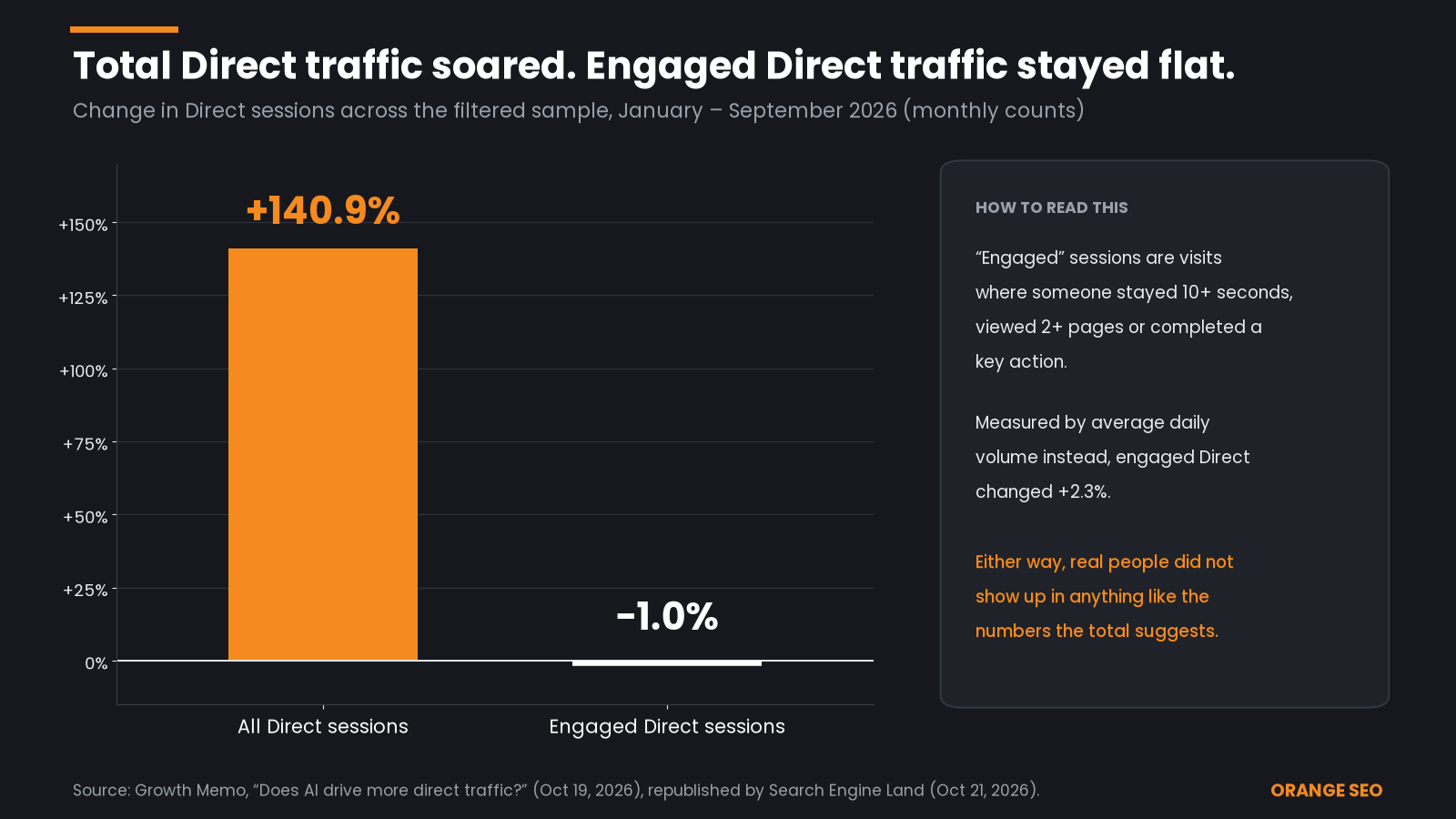
Total Direct traffic soared. Engaged Direct traffic didn't.
GA4 counts a visit as "engaged" when someone stays longer than 10 seconds, views at least two pages, or completes an important action such as a form submission (how GA4 defines engagement). Bots usually fail all three tests.
When the study separated engaged visits from the total, the picture became clear. Across the filtered January–September 2026 sample:
- Total Direct sessions rose 140.9%.
- Engaged Direct sessions changed −1.0% in monthly counts. Measured as average daily volume instead, they rose just 2.3%.
In other words, the real people arriving through Direct barely changed all year. Almost all of the growth was in visits that did nothing.
Source: Growth Memo, “Does AI drive more direct traffic?” (Oct 19, 2026), republished by Search Engine Land.
Visible AI traces were almost nonexistent
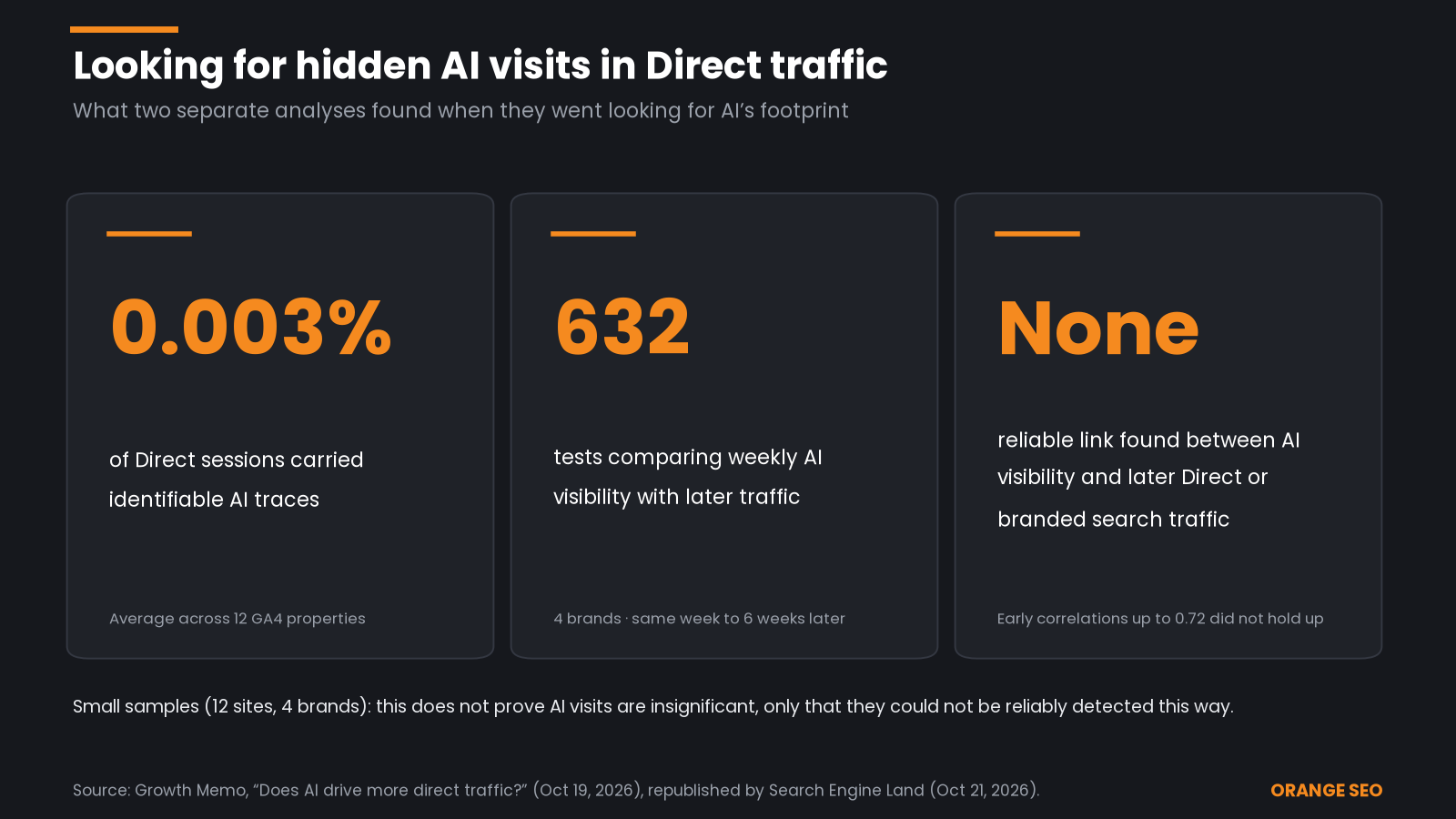
The study also looked for Direct visits that carried any identifiable trace of an AI tool. On average across the 12 sites, those made up just 0.003% of Direct traffic. Without customers telling them, the researchers couldn't detect a meaningful amount of hidden AI traffic.
By the numbers: 0.003% is about 3 visits in every 100,000 Direct sessions. Even if the true number is several times higher, it is nowhere near enough to explain a Direct traffic surge.
A second test: does AI visibility lead to more Direct or branded searches?
A separate analysis of four brands asked a related question. When a brand shows up more often in AI answers, do more people search for it by name or visit directly a few weeks later?
It ran 632 tests, comparing weekly AI visibility with later traffic at delays from the same week up to six weeks. A few early results looked promising, including one correlation as high as 0.72.
But when those results were checked against deliberately mismatched weeks, several wrong pairings did just as well or better. The patterns also didn't hold steady across different time periods. The conclusion: no reliable link between rising AI visibility and later Direct or branded search traffic could be established. An effect may still exist. It just couldn't be isolated.
Source: Growth Memo, “Does AI drive more direct traffic?” (Oct 19, 2026), republished by Search Engine Land.
Why this matters for your business
It's important to read this research for what it is, and what it isn't.
What it doesn't prove: This was a small group of 12 websites, mostly B2B, plus four brands in the second test. That is not a representative sample of all businesses. It does not prove AI visits are insignificant, and it doesn't mean AI tools never send people to your website.
In fact, one finance software company has publicly said it traced 30–40% of its Direct traffic to AI answer engines. It did that by studying Direct visits to long blog URLs, filtering out email patterns, comparing behavior with search visitors, and, crucially, confirming with customers who said they came from AI. Separate research cited in the same analysis found that people who got an AI brand recommendation were more likely to visit that brand's site within a week, but mostly through search rather than by typing the address.
What it does show: A rising Direct line is not automatic proof that your AI optimization is working. If an SEO agency or report points to Direct growth as evidence of AI success, ask a simple follow-up question: how much of that traffic is engaged, and how many leads came from it?
Our view: AI search is real and growing, and businesses should invest in being visible there. But "traffic went up" is not the same as "customers came in." Measure what actually reaches your sales team.
How to tell if your Direct traffic is real or bots
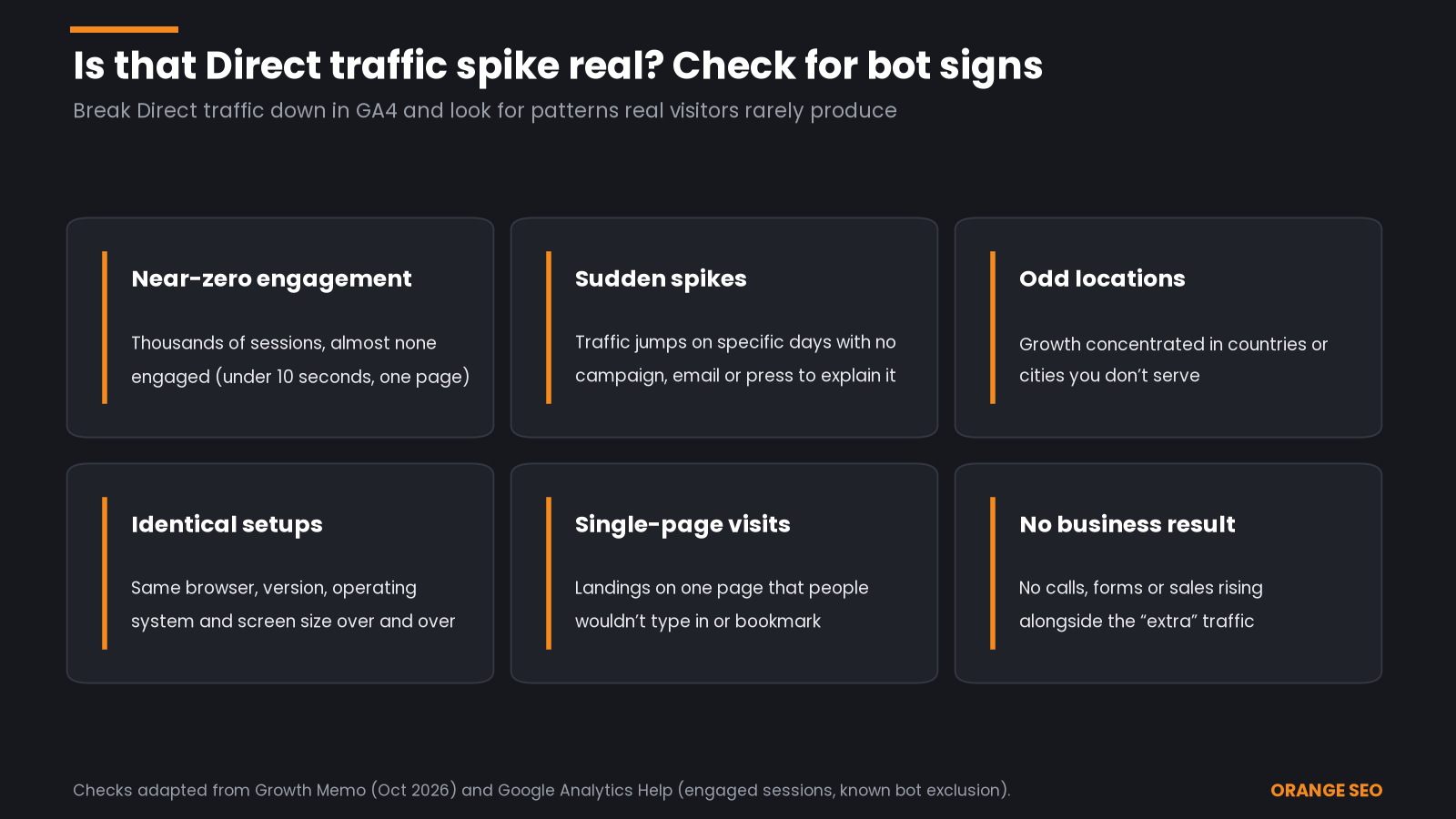
GA4 already filters out known bots and spiders automatically, but newer or disguised bots can still slip through. Before you celebrate (or panic about) a Direct traffic jump, break it down in GA4 by day, landing page, country, browser, operating system and screen size. Watch for these warning signs:
- Near-zero engagement: thousands of sessions, almost none engaged.
- Sudden spikes: jumps on specific days with no campaign, email or press coverage to explain them.
- Odd locations: growth concentrated in countries or cities you don't serve.
- Identical setups: the same browser, version, operating system and screen size, over and over.
- Single-page visits: landings on pages people would never type in or bookmark, followed by an instant exit.
- No business result: no rise in calls, form fills or sales alongside the "extra" traffic.
Sources: Growth Memo (Oct 2026); Google Analytics Help.
If several of these show up together, treat the growth as suspect and keep it out of your AI success reporting.
A better way to measure AI search: three outcomes
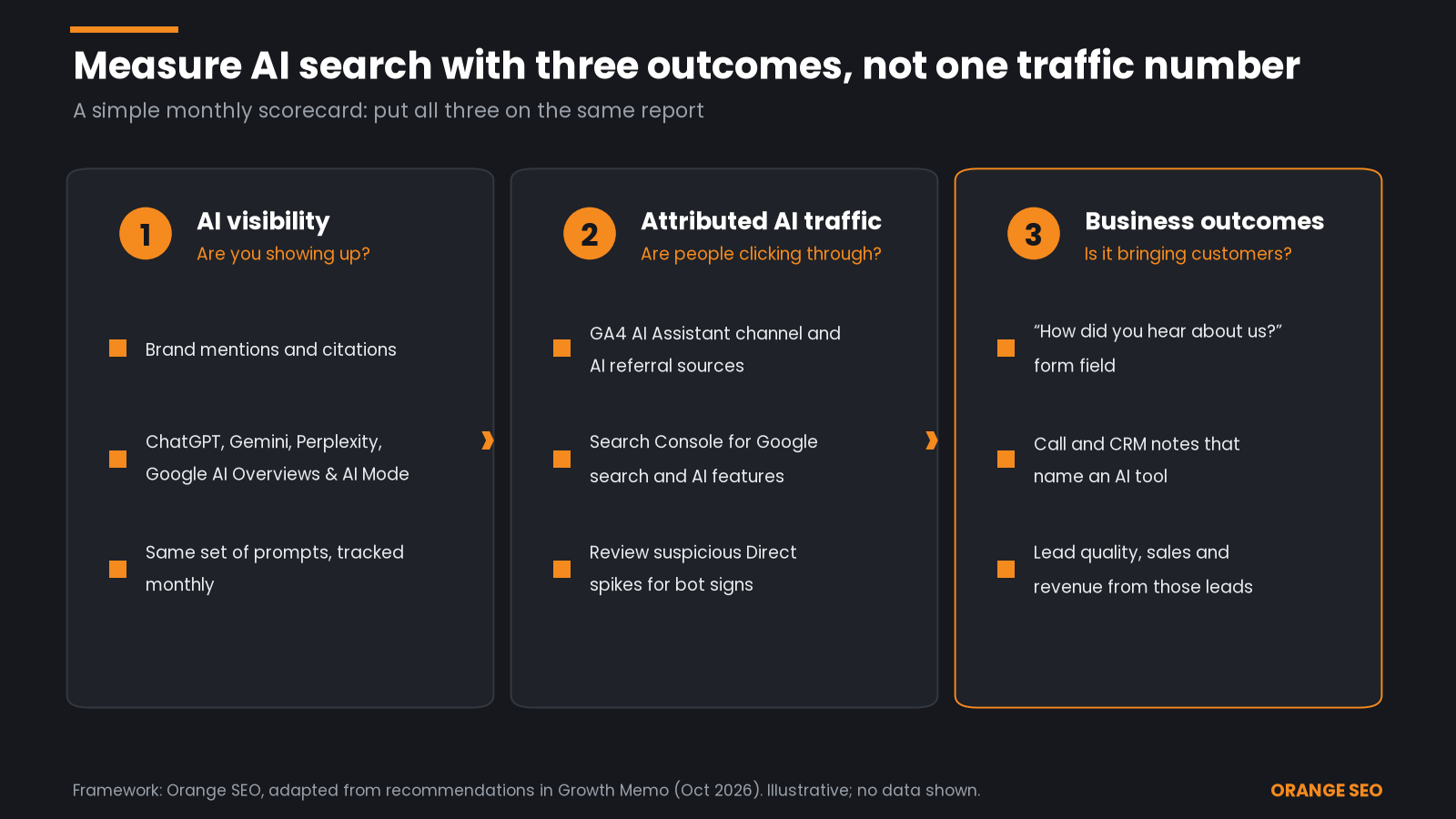
Instead of guessing from Direct traffic, measure AI search the way you'd measure any marketing channel: by exposure, by visits you can actually attribute, and by results. We recommend putting all three on the same monthly report.
Framework: Orange SEO, adapted from Growth Memo (Oct 2026).
1. AI visibility: are you showing up?
Track whether AI tools mention, recommend and cite your business. Use a consistent set of questions your customers actually ask, such as "best accounting software for small businesses" or "top-rated roofer in my city," across ChatGPT, Gemini, Perplexity, Microsoft Copilot and Google's AI Overviews and AI Mode.
Check the same questions every month so you can see real trends. Note whether you're mentioned, whether your website is linked as a source, and whether the details about your business are correct. This is the core of our AI citation outreach work: earning mentions on the trusted sites that AI tools pull from. For the basics, see our guide to becoming a source for AI answers.
2. Attributed AI traffic: are people clicking through?
Some AI visits are trackable. GA4 now has an AI Assistant channel for visits from tools such as ChatGPT, Gemini, Copilot and others. Note that clicks from Google's AI Overviews and AI Mode are counted under Organic Search instead, and they show up in Google Search Console as part of your overall web search data.
Review these numbers monthly alongside your Organic Search results. At the same time, keep an eye on Direct traffic using the bot checklist above, so suspicious spikes don't get mistaken for AI success. Our earlier post on how AI search is changing marketing attribution goes deeper on why some AI influence will never show up as a click.
3. Business outcomes: is AI bringing customers?
This is the measure that matters most, and the one analytics tools can't capture alone. Ask people directly:
- Add a "How did you hear about us?" field to your contact and booking forms, and include options like "ChatGPT or another AI tool" and "Google AI answer."
- Train whoever answers the phone to ask the same question and log the answer in your CRM or call notes, in the customer's own words.
- Follow the leads who mention AI through to the end: did they book, buy, and stay?

Asking every new lead how they found you is the most reliable AI attribution signal.
When you line up all three, the story gets clearer. If AI visibility is rising but customers rarely mention AI, check whether you're tracking the questions buyers really ask. If more customers say they found you through AI, look at whether those leads turn into good customers.
What we recommend for your reporting
Here's how to put this into practice without overhauling everything:
- Keep Search Console and GA4 as your foundation. They remain the best free view of how Google search and your website perform.
- Add AI brand mention and citation monitoring alongside them, using a fixed set of customer questions checked monthly across the major AI tools.
- Clean up Direct traffic before you read it. Look at engaged sessions, not just total sessions, and flag bot-like patterns.
- Capture lead source at every touchpoint, including forms, phone calls and your CRM.
- Judge marketing by lead quality, not traffic volume. A smaller number of well-qualified leads is worth far more than a big traffic chart. Our guide on improving lead quality covers how to tell the difference.
This is also why we've long cautioned that the hype around "AI traffic" can miss the mark. Being visible in AI answers matters. Pretending every unexplained visit is an AI win does not.
Get clear on what AI search is really doing for you
Orange SEO helps businesses get found in Google and in AI tools like ChatGPT, Gemini and Perplexity, and then measure it honestly. Our SEO and AI search services combine traditional search work with AI visibility tracking, and our on-page SEO makes your website a clear, trustworthy source for both.
Want to know whether AI is actually sending you customers? Contact Orange SEO and we'll help you set up reporting built around leads, not just traffic.
Frequently asked questions
Does AI drive direct traffic?
It can, but it's hard to prove from analytics alone. A recent analysis of 12 GA4 accounts found that most Direct traffic growth came from bots, engaged Direct visits were flat, and identifiable AI traces were only 0.003% of Direct sessions. At least one company has confirmed AI-driven Direct visits by asking customers how they found them.
Why is my Direct traffic going up in GA4?
Common causes include bot traffic, links in emails or apps that don't pass a source, bookmarks, and tracking issues. Check engaged sessions, locations, devices and landing pages. If the growth has almost no engagement, it is probably not real people.
Can GA4 track traffic from ChatGPT and other AI tools?
Partly. GA4 has an AI Assistant channel for visits referred by tools like ChatGPT, Gemini and Copilot. Visits from Google's AI Overviews and AI Mode are counted as Organic Search. Visits where someone types your address after seeing an AI answer will still show as Direct.
How should I measure AI search visibility?
Track a fixed set of customer questions across ChatGPT, Gemini, Perplexity, Copilot and Google's AI features each month, and record whether your business is mentioned, linked and described correctly. Pair that with attributed AI traffic and lead-source data.
What is the best way to know if AI is bringing in customers?
Ask them. Add a "How did you hear about us?" field to forms, log answers from phone calls in your CRM, and follow those leads through to sales. Self-reported answers are the most reliable signal available today.
Figures describe the researchers' own samples and methods. The 12-site study leaned toward B2B companies and is not representative of all businesses.
Sources
- Growth Memo, "Does AI drive more direct traffic?" (Oct 19, 2026): https://www.growth-memo.com/p/does-ai-drive-more-direct-traffic
- Search Engine Land, "Does AI drive more direct traffic?" (Oct 21, 2026): https://searchengineland.com/does-ai-drive-more-direct-traffic-497294
- Google Analytics Help, "Default channel group": https://support.google.com/analytics/answer/9756891?hl=en
- Google Analytics Help, "[GA4] Engagement rate and bounce rate": https://support.google.com/analytics/answer/12195621?hl=en
- Google Analytics Help, "Known bot-traffic exclusion": https://support.google.com/analytics/answer/9888366?hl=en
- Google Search Central, "AI features and your website": https://developers.google.com/search/docs/appearance/ai-features