AI search · Search data · SEO strategy
Google may be showing automated tools a different version of search than the one your customers see. Since late September 2026, several rank-tracking and search-data companies have reported Google poisoned SERPs: complete, normal-looking results pages in which most of the usual websites have been swapped out. The same pipelines that feed many SEO tools also feed some AI products, so the question for businesses goes beyond rank reports. It is whether the information AI assistants find about you is accurate.
By Orange SEO Team · October 26, 2026 · Research covers reports published September–October 2026
People searching Google normally still appear to see accurate listings. What vendors describe is narrower, and arguably more serious for data quality. Traffic that Google appears to treat as automated sometimes gets a page that looks perfectly real but lists the wrong sites.
The takeaway: Don't build your AI visibility on any single pipeline of scraped Google data. Make your own website, your business listings and your citations across trusted sources so clear and consistent that every AI system, whatever index it draws on, finds the same accurate story.
What are Google poisoned SERPs?
A "poisoned" SERP is the term rank-tracking firm Nozzle uses for a Google results page that answers the query but has had most of the keyword's usual sites replaced. In its Poisoned Google SERPs study, Nozzle says there is no error message, no captcha and nothing in the HTML to flag the page. You only spot it by comparing the page with that keyword's history.
Vendors draw the line between a block and a poisoned page this way:
- A blocked request fails visibly. The scraper knows to try again.
- A poisoned request succeeds. The data gets stored as real, which is why Nozzle calls it poisoning rather than blocking.
Google has not publicly confirmed the practice or explained why it is happening. Everything below comes from vendor measurements, statements and industry reporting, and we describe it that way.
The evidence so far: what vendors are reporting
Several independent companies have now described the same pattern, though their rates differ widely.
- Nozzle analyzed 29.9 million SERPs since September 13. On page 1 alone, 8.7% were poisoned, against 0.17% in its August–early September baseline. The page-1 rate peaked at 28.6% on September 29. Counting page 1 or page 2, the figure is 22.6% (Nozzle).
- Ahrefs told customers on October 22 that Google has been "poisoning" results, "where different results are shown to suspected SERP data providers." It estimates that 5% to 20% of results are affected, depending on the data provider (PPC Land; Search Engine Roundtable).
- Semrush confirmed it has seen "Google returning inaccurate results since late summer" but described the impact on tracked rankings as limited (Search Engine Roundtable).
- AccuRanker said that on October 24, Google poisoned 40% of its first desktop fetches. After its own re-checks, about 3.2% reached stored data (AccuRanker).
- SerpApi, the scraping company Google is suing, listed an unresolved incident on its public status page as of October 26: searches "returning irrelevant/poisoned results" (SerpApi status).
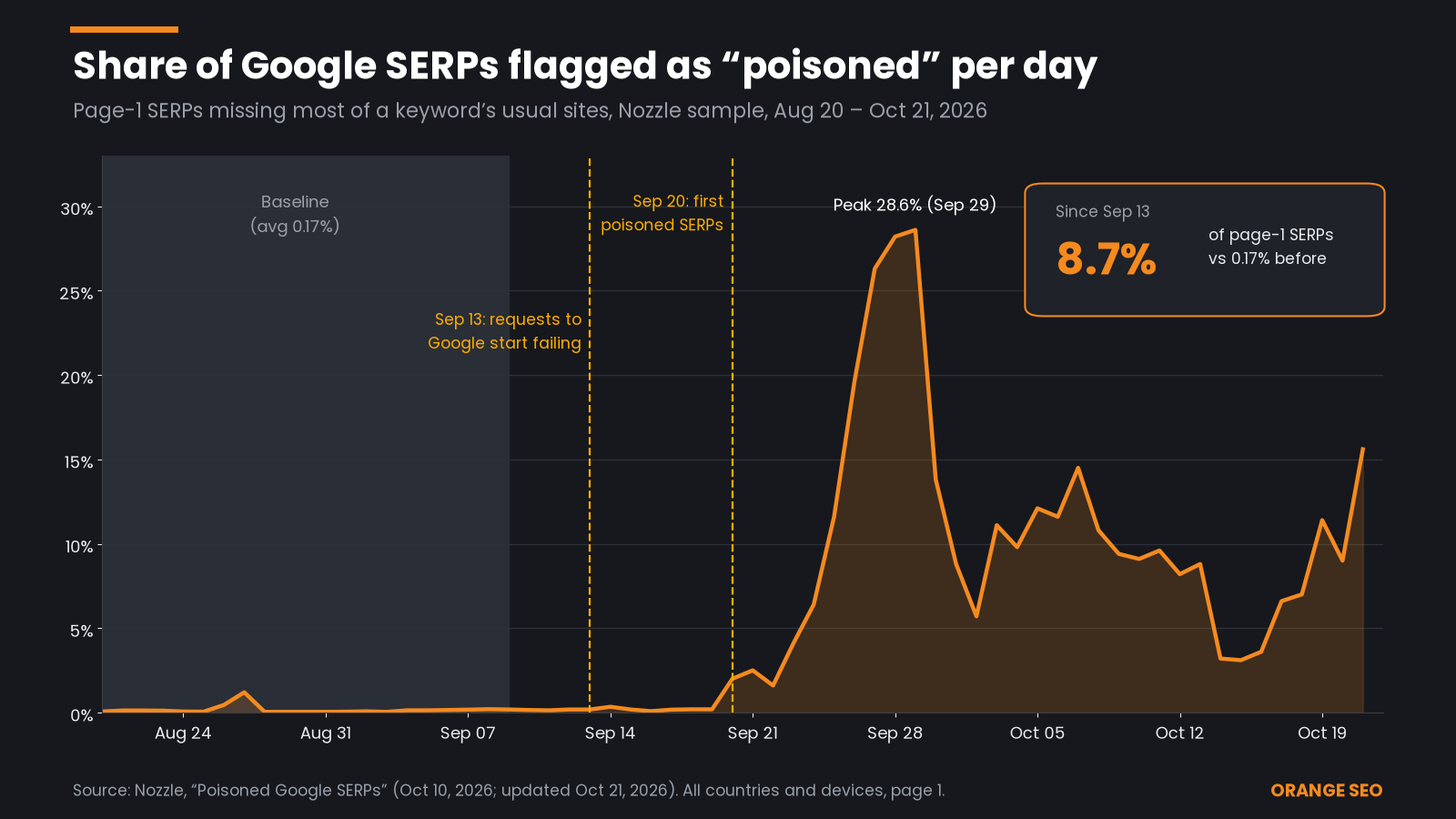
Source: Nozzle, “Poisoned Google SERPs,” data through October 21, 2026.
By the numbers: In Nozzle's data, a project's own website fell out of the top 10 on 60.8% of poisoned SERPs, compared with 2.7% normally. And 67.9% of affected keywords had their usual sites back within three days (Nozzle).
Not everyone sees the same scale. AccuRanker argues that poisoning follows how data is collected (browser sessions) rather than what is tracked. That would explain why rates vary so much between providers.
What a poisoned page looks like
According to Nozzle, the blue links change most. On poisoned SERPs, organic results kept only 22.3% of the previous page's sites, versus 88.1% normally. Social platforms and forums such as Facebook, Instagram, Quora and Reddit filled more of the gaps. Ads and Shopping results stayed stable.
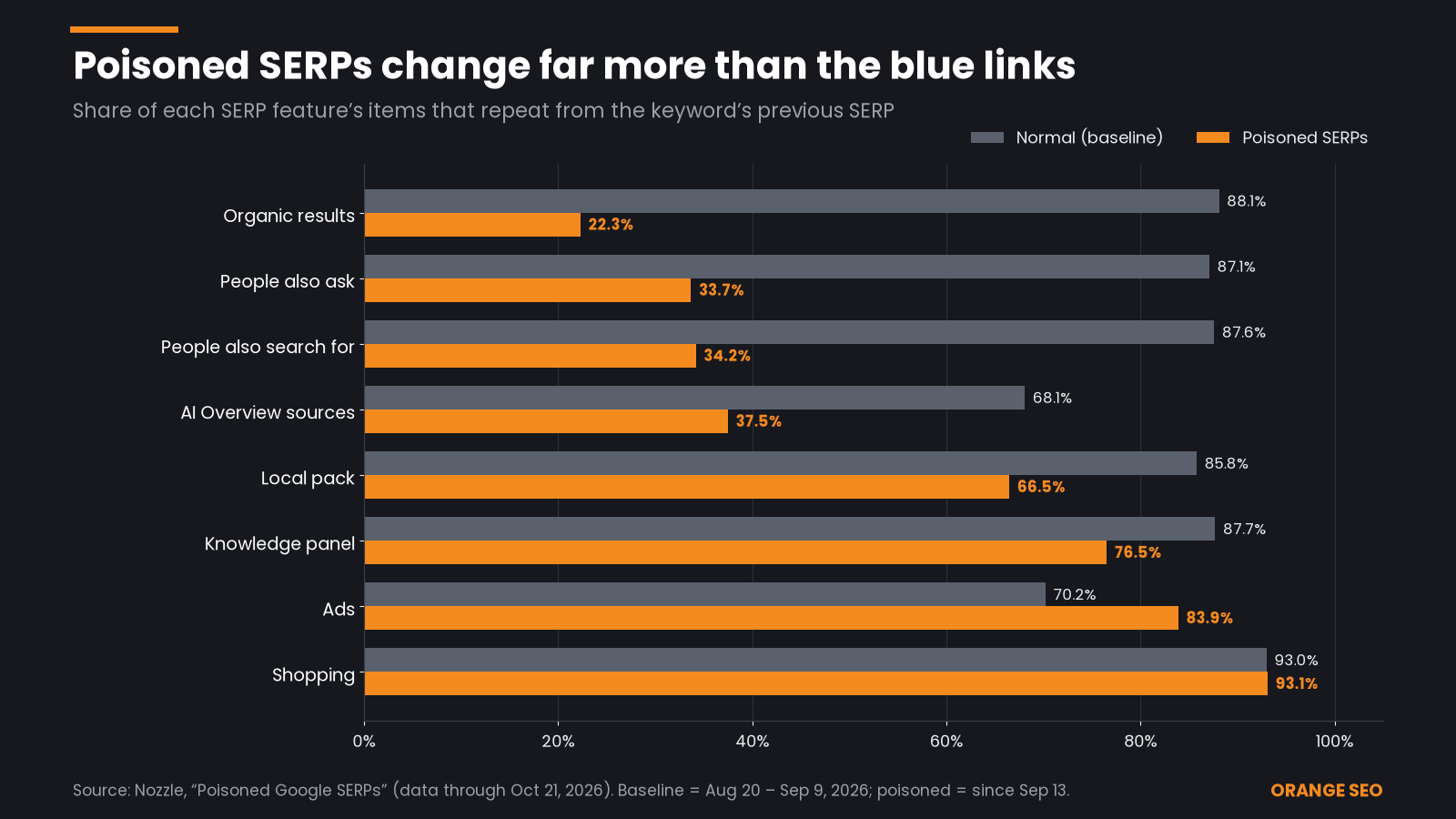
Source: Nozzle, “Poisoned Google SERPs,” data through October 21, 2026.
| What changes | Normal results page | Poisoned results page (reported) |
|---|---|---|
| Who sees it | People searching normally; most tool requests | Automated traffic Google appears to flag as suspicious |
| Organic sites kept from previous SERP | 88.1% | 22.3% |
| AI Overview sources kept | 68.1% | 37.5% |
| Tracked site missing from top 10 | 2.7% | 60.8% |
| Ads and Shopping | Stable | Stable |
| Visible warning | None needed | None (looks complete) |
Source: Nozzle; "who sees it" reflects vendor reports, not a Google statement.
How we got here: Google's escalating fight against scraping
Poisoned pages are the latest step in a long series of documented moves that make Google results harder to collect automatically.
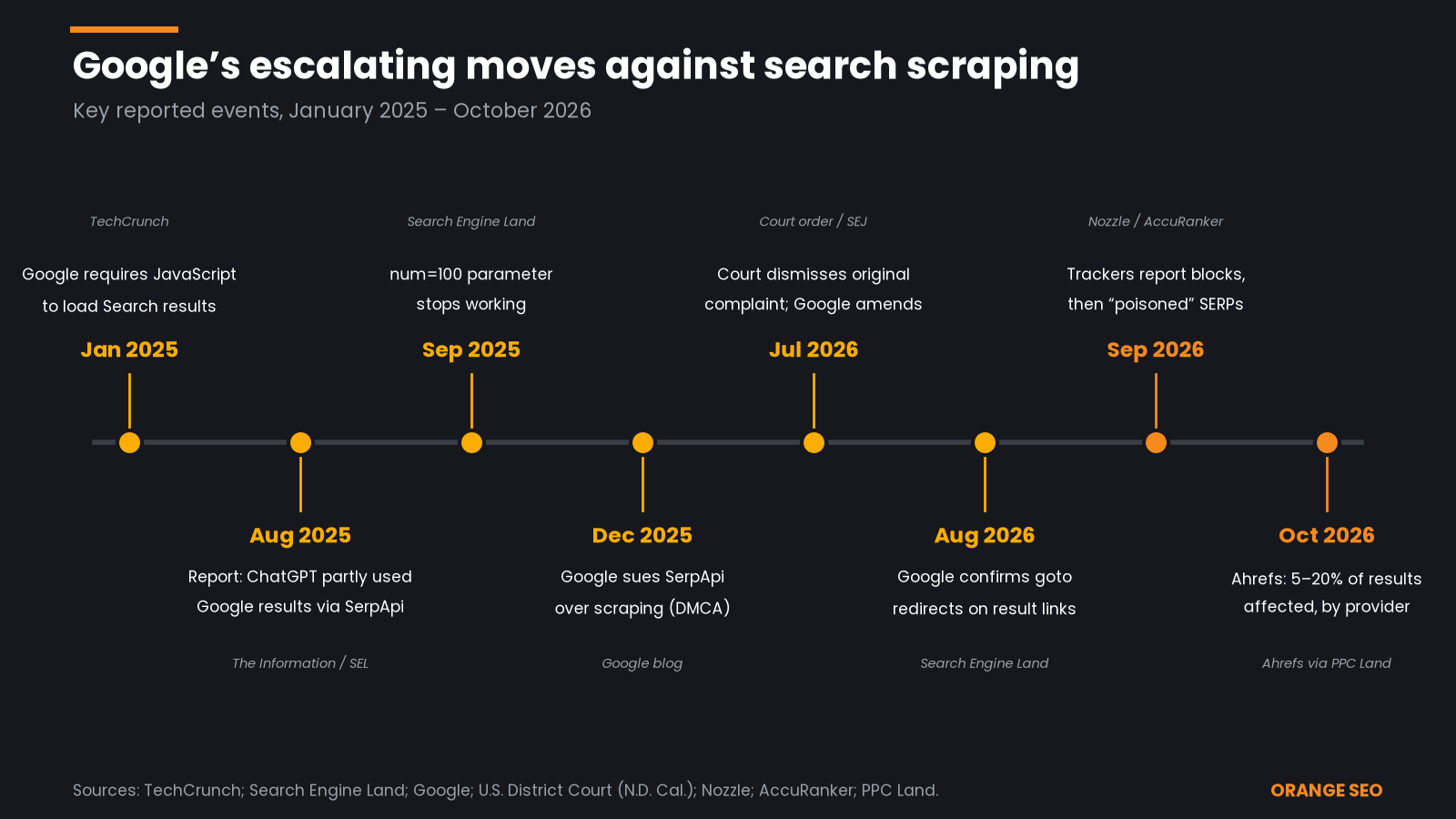
Sources: TechCrunch, Search Engine Land, Google, U.S. District Court (N.D. Cal.), Nozzle, AccuRanker, PPC Land.
- January 2025: JavaScript required. Google began requiring JavaScript for Search, telling TechCrunch it helps "protect our services and users from bots and evolving forms of abuse and spam." Court filings later describe this protection, called SearchGuard, as a JavaScript "challenge" sent to unrecognized traffic (court order).
- August 2025: ChatGPT and SerpApi. The Information reported that OpenAI had partly used SerpApi-scraped Google results for some real-time ChatGPT answers, and that Perplexity was also a SerpApi customer (Search Engine Land; Search Engine Roundtable).
- December 2025: Lawsuit. Google sued SerpApi, alleging it circumvents Google's security measures. In July 2026 the court dismissed the original complaint, partly with leave to amend, and Google filed an amended complaint (court order; Search Engine Journal). The case is ongoing.
- August 2026: goto redirects. Google confirmed it was routing result links through redirect URLs as "technical measures against evolving forms of abuse" (Search Engine Land).
The num=100 change was the warning shot
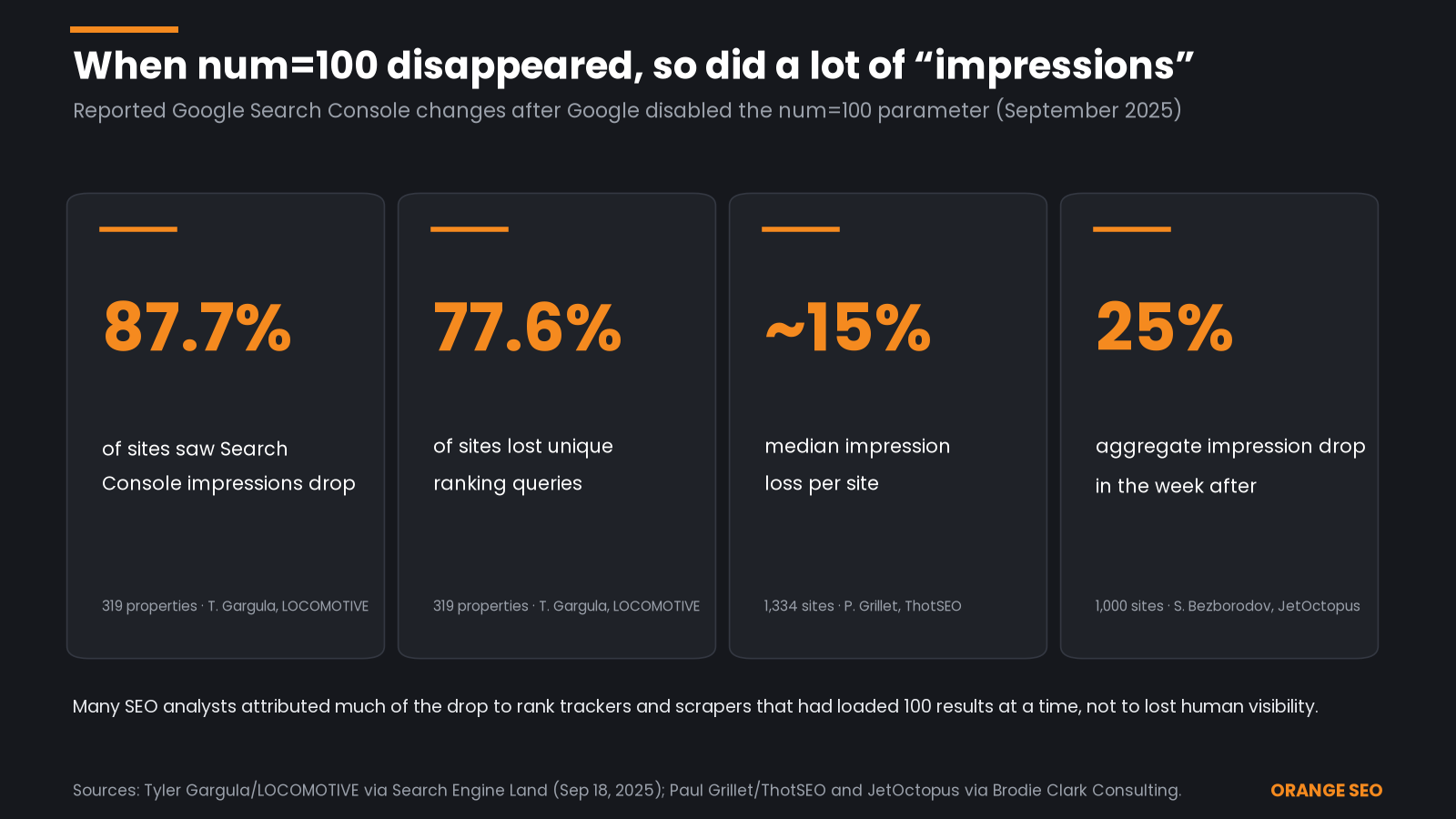
In September 2025, Google stopped supporting the &num=100 parameter that let tools load 100 results per request. A spokesperson said it was "not something that we formally support" (Search Engine Land). Search Console data shifted almost overnight.
Sources: Tyler Gargula/LOCOMOTIVE via Search Engine Land; Paul Grillet/ThotSEO and JetOctopus via Brodie Clark Consulting.
Many SEOs concluded that a meaningful share of desktop "impressions" had been generated by tools rather than people (Brodie Clark; Search Engine Land). That episode showed that Google's search data for machines and for humans can diverge, and that the gap only becomes visible when Google changes the rules.
What poisoned SERPs mean for AI search visibility
Here's where the issue moves from SEO tooling to your bottom line. The AI platforms your customers use get their web information in different ways. Those differences decide how exposed each one is.

Illustration: the same search, two very different results.
AI tools that rely on scraped Google results
Nozzle describes the poisoning as "Google's response to AI scraping," with rank trackers "caught in it." Search Engine Roundtable's Barry Schwartz has said he believes Google's real targets are AI bots and SerpApi rather than SEO tools (Search Engine Roundtable). Those are informed interpretations, not confirmed motives.
We have not seen public evidence showing specific ChatGPT or Perplexity answers changed because of poisoned pages. The risk is still logical. Any product that grounds answers in scraped Google pages could receive a version where established businesses are missing and forums or social posts take their place.
ChatGPT also leans on Bing
OpenAI says ChatGPT search "leverages third-party search providers" alongside partner content (OpenAI). Its Enterprise documentation states that ChatGPT may share search queries with Bing to return web results (OpenAI Help Center). If your business is weak or wrong in Bing, that can matter as much as your Google rankings. Our Bing vs. Google breakdown covers the basics.
Gemini and AI Overviews draw on Google directly
Google's own AI features don't need to scrape Google. Google's crawler documentation explains that Google-Extended controls whether content can be used for Gemini training and for grounding in Gemini Apps, and that it does not affect Search inclusion or rankings (Google for Developers). In practice, your traditional Google SEO still flows into AI Overviews and Gemini, as we explained in why large language models need Google.
Perplexity and the wider crawling fight
The battle over AI access runs in both directions. In August 2025, Cloudflare alleged that Perplexity used "stealth, undeclared crawlers" to get around website blocks (Cloudflare). Perplexity disputed the findings (Perplexity). The broader lesson: the pipelines between websites, search engines and AI assistants are contested and can change without notice.
Is this "cloaking"?
Google's spam policies define cloaking as showing different content to users and search engines "with the intent to manipulate search rankings and mislead users" (Google Search Central). That policy governs websites, not Google's own results, so the comparison is imperfect. The practical parallel is still worth noting: what a machine sees and what a person sees can differ. Your job is to make sure the truth about your business is the same everywhere.
Why local and service businesses should pay attention
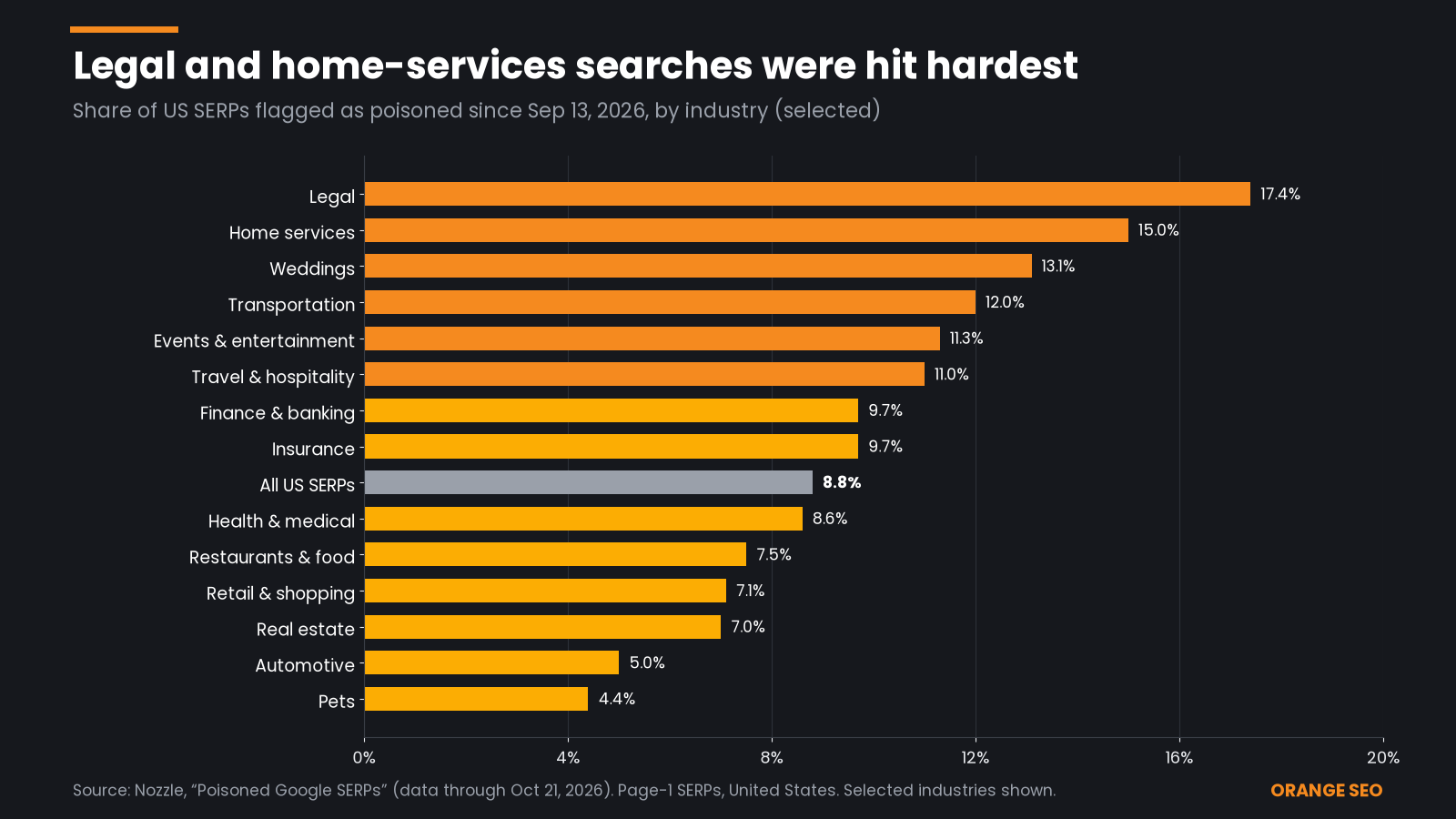
In Nozzle's US data, the most affected categories were legal (17.4%) and home services (15.0%), well above the 8.8% US average. "Near me" searches were also affected more often (13.6%) than other searches (8.6%).
Source: Nozzle, “Poisoned Google SERPs,” data through October 21, 2026. Selected industries shown.
That has two consequences. Rank reports from late September and October may show "drops" that real customers never saw. And any AI product working from degraded pages could under-represent precisely the local businesses that depend on being recommended.
What to do now: 6 steps to protect your AI visibility
1. Verify before you react to ranking drops
AccuRanker's advice is a good rule of thumb: a one-day drop that reverses the next day, especially when your usual competitors vanish too, is more likely bad data than a penalty. Cross-check the same query and date in Google Search Console. If clicks and average position held steady, nothing happened to your site (AccuRanker).
2. Make your entity information consistent everywhere
AI systems piece together who you are from many sources. Keep your business name, address, phone, services, hours and descriptions identical across your website, Google Business Profile, Bing Places, Apple Business Connect and major directories. Our local citation packages are built for exactly this.
3. Strengthen your own website as the source of truth
Publish clear, crawlable service pages that answer real customer questions directly. Add accurate Organization, LocalBusiness, Service and FAQ structured data. Strong on-page SEO gives every crawler, from Googlebot to OAI-SearchBot, the same unambiguous facts.
4. Don't be Google-only
- Verify your site in Bing Webmaster Tools and submit your sitemap.
- Confirm your robots.txt doesn't accidentally block AI search crawlers you want, such as OpenAI's OAI-SearchBot (OpenAI).
- Decide deliberately on training-only controls such as Google-Extended and GPTBot, rather than leaving them to defaults.
5. Earn citations across trusted sources
When AI tools can't rely on one index, consistent mentions in respected industry publications, associations and review platforms become your safety net. Our AI citation outreach service focuses on earning that kind of credible, independent coverage. For the strategy behind it, see how to become a source for AI answers.
6. Monitor AI answers directly
Rank trackers measure Google positions, and right now even that data needs checking. Track what ChatGPT, Perplexity, Gemini, Copilot and AI Overviews actually say about your business for your most important questions. Record the answers and their sources monthly, and fix inaccuracies at the source.
Our view: accuracy is now a visibility strategy
The poisoned-SERP reports show something bigger than a rank-tracking glitch. The AI search ecosystem runs on data pipelines your business doesn't control, and any of them can be degraded, blocked or rerouted overnight.
At Orange SEO, we believe the durable answer is the same one that has always worked in SEO, applied more broadly: be the clearest, most consistent and most credible source about your own business, everywhere a person or a machine might look. That's the foundation of our AI SEO, GEO and AIO services.
Make sure AI gets your business right
Orange SEO helps businesses strengthen their entity signals, structured data, citations and multi-platform search presence, so accurate information reaches customers on Google and in AI answers alike. Talk to Orange SEO about an AI visibility review.
Frequently asked questions
What are Google poisoned SERPs?
It's a term rank-tracking vendors use for Google results pages served to suspected automated traffic that look normal but list mostly different, less relevant sites than usual. Google has not confirmed the practice or explained it publicly.
Does Google show real customers inaccurate results?
The reports describe pages served to traffic that Google appears to flag as automated, such as rank trackers and data scrapers. Vendors suggest checking Search Console, which reflects real searches, when a tracked ranking suddenly drops.
Are ChatGPT and Perplexity answers affected?
There's no public evidence yet tying specific AI answers to poisoned pages. However, OpenAI and Perplexity were reported in 2025 to be SerpApi customers, and SerpApi has publicly reported returning "irrelevant/poisoned results." Any AI product that relies on scraped Google data could be exposed.
Are Google AI Overviews and Gemini affected?
Google's own AI features draw on Google's own index rather than scraped copies of its results pages, and the vendor reports don't describe them as affected. Strong traditional Google SEO remains the main way to earn visibility in AI Overviews and Gemini.
How can I tell if a ranking drop is real?
Look for drops that reverse within a day or two, check whether most competitors vanished at the same time, and compare against Search Console clicks and average position for that query and date. A real ranking change usually persists.
What's the best way to protect my AI search visibility?
Keep your business information consistent everywhere, publish clear structured content on your own site, build presence in Bing as well as Google, earn citations from trusted sources and monitor AI answers directly.
Research note: This article distinguishes vendor measurements and industry reporting from confirmed Google behavior. Google has not publicly commented on poisoned-SERP reports as of October 26, 2026. Figures describe each vendor's own sample and method and may change as studies are updated.
Sources
- Nozzle, "Poisoned Google SERPs" (Oct 10, 2026; updated Oct 21, 2026): https://nozzle.io/research/poisoned-google-serps/
- PPC Land, "Ahrefs says Google poisons 5% to 20% of results served to SEO data tools" (Oct 22, 2026): https://ppc.land/ahrefs-says-google-poisons-5-to-20-of-results-served-to-seo-data-tools/
- Search Engine Roundtable, "Third-Party Google Rank Tracking Struggling Now" (Oct 12, 2026, updated): https://www.seroundtable.com/third-party-google-rank-tracking-broken-42272.html
- AccuRanker, "How AccuRanker Handles Poisoned SERPs" (Oct 19, 2026, updated): https://www.accuranker.com/blog/poisoned-serps/
- SerpApi status page (accessed Oct 26, 2026): https://status.serpapi.com/
- Search Engine Journal, "Analysis: Google Is Poisoning Search Results For Rank Trackers" (Oct 14, 2026): https://www.searchenginejournal.com/analysis-google-is-poisoning-search-results-for-rank-trackers/592873/
- TechCrunch, "Google begins requiring JavaScript for Google Search" (Jan 17, 2025): https://techcrunch.com/2025/01/17/google-begins-requiring-javascript-for-google-search/
- Search Engine Land, "Google Search confirms it does not support the results per page parameter" (Sep 18, 2025): https://searchengineland.com/google-search-confirms-it-does-not-support-the-results-per-page-parameter-462244
- Search Engine Land, "77% of sites lost keyword visibility after Google removed num=100" (Sep 18, 2025): https://searchengineland.com/google-num100-impact-data-462231
- Brodie Clark Consulting, "Were We Wrong About 'The Great Decoupling' After All?": https://brodieclark.com/the-great-decoupling-num100/
- Search Engine Land, "ChatGPT's answers came from Google Search after all: Report" (Aug 26, 2025): https://searchengineland.com/openai-chatgpt-serpapi-google-search-results-461226
- Google, "Why we're taking legal action against SerpApi's unlawful scraping" (Dec 19, 2025): https://blog.google/innovation-and-ai/technology/safety-security/serpapi-lawsuit/
- U.S. District Court (N.D. Cal.), Google LLC v. SerpApi LLC, order on motion to dismiss (Jul 20, 2026): https://cdn.arstechnica.net/wp-content/uploads/2026/07/Google-v-SerpApi-Order-GRanting-Motion-to-DIsmiss-7-20-26.pdf
- Search Engine Land, "Google confirms deploying goto URL redirects to search results links" (Aug 26, 2026): https://searchengineland.com/google-confirms-deploying-goto-url-redirects-to-search-results-links-485926
- OpenAI, "Introducing ChatGPT search": https://openai.com/index/introducing-chatgpt-search/
- OpenAI Help Center, "ChatGPT search for Enterprise and Edu": https://help.openai.com/en/articles/10093903-chatgpt-search-for-enterprise-and-edu
- Google for Developers, "Google's common crawlers" (Google-Extended): https://developers.google.com/crawling/docs/crawlers-fetchers/google-common-crawlers
- Cloudflare, "Perplexity is using stealth, undeclared crawlers to evade website no-crawl directives" (Aug 4, 2025): https://blog.cloudflare.com/perplexity-is-using-stealth-undeclared-crawlers-to-evade-website-no-crawl-directives/
- Perplexity, "Agents or Bots? Making Sense of AI on the Open Web": https://www.perplexity.ai/hub/blog/agents-or-bots-making-sense-of-ai-on-the-open-web
- Google Search Central, "Spam policies for Google web search": https://developers.google.com/search/docs/essentials/spam-policies
- OpenAI, "Overview of OpenAI Crawlers": https://developers.openai.com/api/docs/bots