
Why Large Language Models Need Google and Why SEO Matters More Than Ever
Large language models (LLMs) are the engines powering the AI revolution. From chatbots and virtual assistants to AI‑generated search results, these models have transformed how people ask questions and get answers. Behind the scenes, however, these systems are only as smart as the information they ingest. This article explains why LLMs rely on Google and other search engines to learn, how good SEO ensures your content is part of their knowledge, and what businesses can do to stay visible in a world dominated by AI answers.
How Do LLMs Learn?
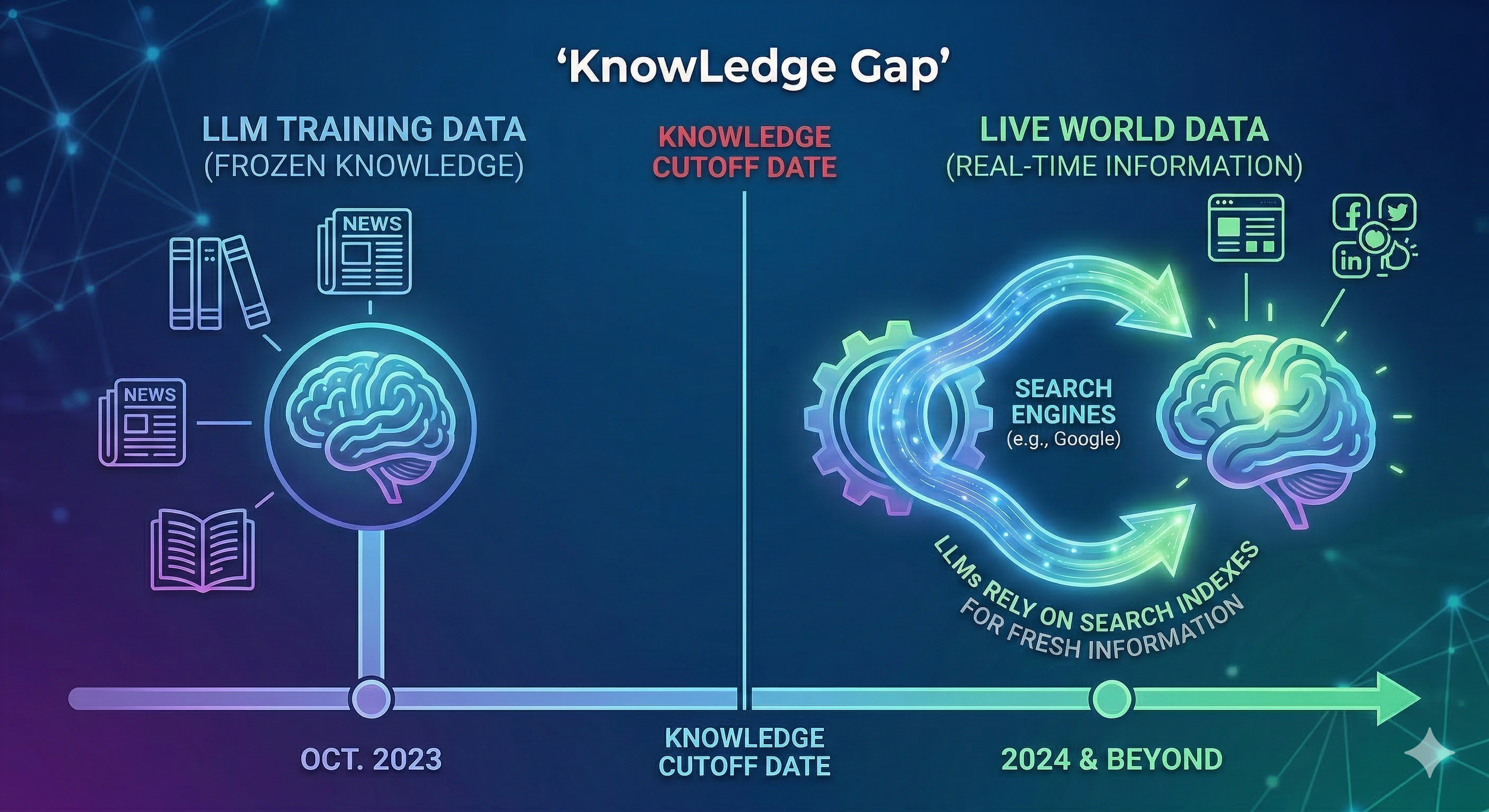
To understand why search engines are critical to LLMs, it helps to know how these models are trained. LLMs are giant neural networks that learn to predict the next word in a sentence by analyzing massive amounts of text. During training, they are fed trillions of tokens sourced from books, articles, websites, forums, and other public data. This process teaches the model grammar, facts, reasoning patterns, and context. The broader and more diverse the training data, the better the model performs.
However, this training process is not continuous. Models like GPT‑4, Gemini or Claude are trained on a dataset frozen at a specific point in time. After that point—called the training cutoff—the model does not automatically know about new events, products or webpages. Retraining a state‑of‑the‑art model is extremely expensive, so companies release updated models periodically rather than daily. Between these updates, the only way an LLM can learn something new is by connecting to real‑time data sources during inference (the moment when the model generates a response). That is where search engines enter the picture.
The Role of Google and Other Search Engines
Search engines such as Google and Bing maintain enormous indexes of the public web. When you use an LLM that supports live search—like ChatGPT with browsing enabled, Google’s Gemini, or Microsoft’s Copilot—the model isn’t magically updating its internal weights. Instead, it submits your query to a search engine, retrieves the top results, and summarizes them for you. If a model doesn’t have access to fresh search results, it will rely on outdated training data and can produce incorrect answers.
In other words, LLMs need search engines to learn about anything that happened after their training cutoff. Without a search engine’s index, the model can’t fetch new information. Google is particularly important because it maintains the most comprehensive web index and dominates search with roughly 90 percent market share. Even tools built by other companies depend on Google’s infrastructure; for example, Perplexity and Gemini use Google’s search APIs, while ChatGPT’s browsing mode is powered by Bing’s index. When people say “without Google, LLMs can’t function,” they mean that modern generative models need the live data and ranking signals that search engines provide.
Search engines also act as gatekeepers of quality. Google and Bing filter spam, rank authoritative pages higher, and penalize low‑quality content. LLMs use those signals to decide which sources to include in their responses. If your page is buried deep in the search results, AI systems will rarely see it when summarizing answers.
Why Good SEO Matters for LLMs
Traditional search engine optimization (SEO) helps your site appear near the top of Google’s results. That same optimization now affects whether LLMs find and trust your content. Here’s why:
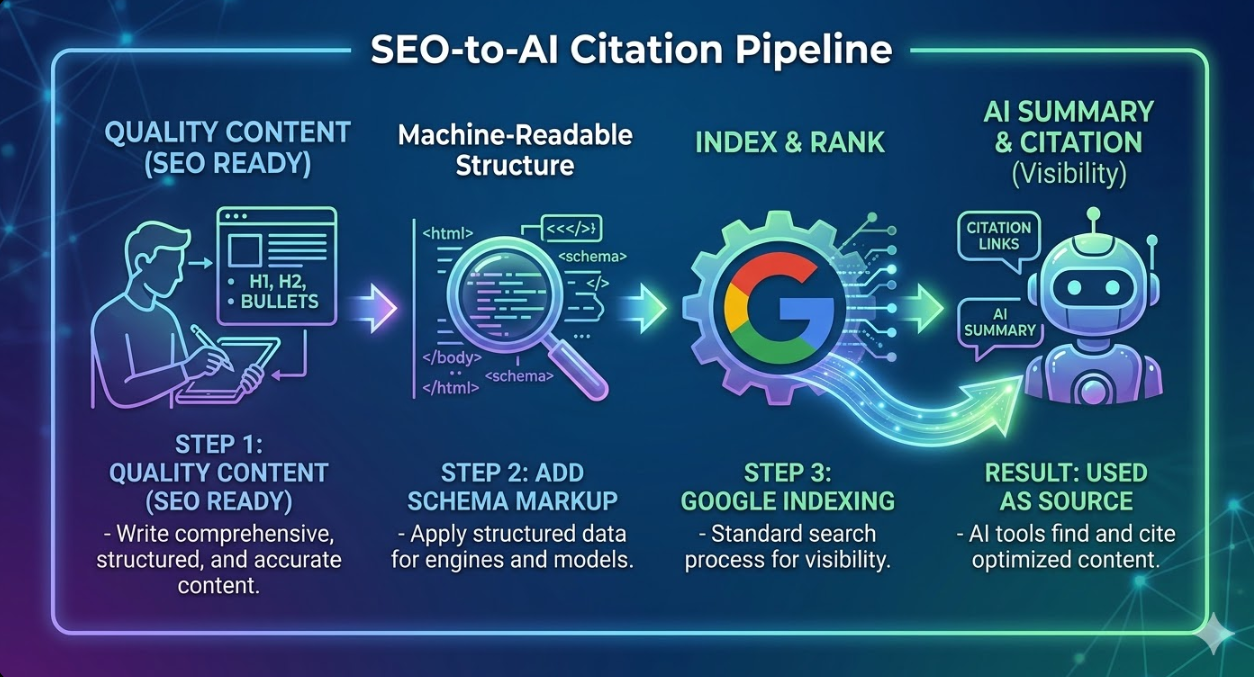
Visibility in AI summaries – AI‑driven search experiences, such as Google’s Search Generative Experience (SGE) and Bing Copilot, show short answers above the blue links. These answers often cite a handful of sources. Pages that rank well in organic search are more likely to be among those citations. If you’re invisible on Google, AI models won’t cite you either.
Machine readability – LLMs need structured, well‑organized content to extract information accurately. SEO best practices such as clear headings, concise paragraphs, bullet lists and schema markup make it easier for both search engines and AI models to parse your pages.
Topical authority – Google’s algorithms and AI systems evaluate the overall expertise and trustworthiness of a site. Consistently publishing in‑depth, accurate content on a subject builds topical authority. When AI models choose sources, they prefer domains with strong authority signals and high‑quality backlinks.
Updated content – Because models fetch current information via search, having up‑to‑date data and referencing recent events can increase your chances of being included. Outdated pages are less likely to rank or be cited.
Good SEO, in short, ensures search engines can discover, index and rank your content—and that AI models can understand and trust it. Optimizing for search and optimizing for AI responses are becoming the same discipline.
What Happens If Search Engines Disappear?
Some have wondered whether AI will replace Google. In reality, LLMs cannot function independently of search. Their training data quickly becomes stale, and without an external index, they have no way to verify facts. Removing search engines would make AI responses less accurate and more prone to hallucination. Even advanced models that perform “reasoning” still require grounding in real‑world data.
Moreover, search engines invest billions of dollars crawling the web, filtering spam, and enforcing policies against misinformation. That curated index is a public good that AI systems rely on. If Google suddenly stopped indexing the web, LLM‑powered chatbots would lose access to an up‑to‑date knowledge base. Rather than replacing search, LLMs are built on top of it.
How to Optimize Your Content for LLMs and AI Search
You don’t need to build your own language model to take advantage of this trend. Instead, focus on making your website a trusted source that both Google and AI engines respect. Consider the following strategies:
Write response‑oriented content. Anticipate the questions users (and AI tools) will ask about your topic. Use those questions as headings and provide direct answers near the top of each section. This makes it easy for models to extract concise summaries.
Use clear structure and schema. Break long articles into sections with descriptive headings, bullet points and tables. Add structured data (e.g., FAQPage, HowTo, Article) to help search engines and AI understand the context of your content. This not only boosts rankings but also increases the likelihood of being cited in AI responses.
Prioritize accuracy and references. AI systems value trustworthy information. Support your statements with reputable data, real statistics and external references (but keep the actual citations out of your reader‑facing copy if you want a cleaner article). Where possible, publish your own studies or link to authoritative sources.
Demonstrate experience and authority. Follow Google’s E‑E‑A‑T (Experience, Expertise, Authoritativeness, Trustworthiness) principles. Include author bios, credentials, and real‑world examples. Earn backlinks from credible sites and encourage mentions across the web—AI systems look for signals that others trust your brand.
Update content regularly. Because AI models use current search results, updating your posts with recent developments keeps them relevant. Reference dates, years and new data to signal freshness. Revise outdated sections and add new insights as the field evolves.
Improve technical foundations. Ensure your site loads quickly, uses HTTPS, and is mobile friendly. Clean code and an XML sitemap help search crawlers index your pages thoroughly. A technically sound site also helps AI models retrieve and parse your content faster.
Build topic clusters and internal links. Group related articles together and interlink them. Topic clusters signal topical authority and help AI models understand the breadth of your expertise. For example, after reading this article, you may want to explore our guides on AI Citation SEO, How to Get Your Business to Show Up in AI Chat Platforms, Generative Engine Optimization (GEO), and AI SEO Optimization. These resources dive deeper into building authority and optimizing for AI‑powered search.
Monitor AI visibility. Periodically run your target queries through AI chatbots like ChatGPT, Gemini or Perplexity. See whether your brand appears and how your content is cited. Use these insights to refine your content and identify gaps.
The Future of SEO and LLM Integration
As AI search experiences mature, the line between traditional SEO and generative engine optimization (GEO) will blur. Google, Microsoft and other tech giants are investing heavily in AI that produces answers instead of lists of links. Yet these answers still originate from indexed web content. That means the best way to prepare for the future is to double down on quality content and technical excellence.

In coming years, we may see:
More personalized AI answers – Models will tailor responses based on user history and preferences. Your content needs to be relevant to specific audiences and contexts to be chosen.
Greater emphasis on source credibility – As misinformation concerns grow, AI providers may weigh authority signals more heavily. Building a strong brand and cultivating expert voices will be essential.
New metrics for success – Click‑through rates may matter less than being cited in AI responses or generating brand awareness through voice answers. Measuring and optimizing for these new metrics will require updated analytics tools.
Integration with other modalities – LLMs are becoming multimodal, combining text with images, video and audio. Well‑structured multimedia content could increase the chances of being included in AI responses.
Emerging technologies – Cutting‑edge fields like quantum computing could accelerate model training and unlock new forms of intelligence. We explore these possibilities in our article Quantum Computing + LLMs: The Road to Superintelligence and the End of Traditional Search as We Know It.
The takeaway? SEO is not dead—it’s evolving. By understanding how search engines and LLMs work together, you can adapt your strategy and ensure your content remains visible, trustworthy and relevant in the age of AI.
AI Isn’t Replacing Google… Here’s Why Video:
FAQ: LLMs, Google and SEO
Do LLMs train on Google search results?
LLMs are initially trained on large datasets that include crawled web pages, books, code repositories and more. They don’t train directly on “search results,” but they do ingest many of the pages that Google indexes. Once trained, models with browsing capabilities query search engines (like Google or Bing) to access fresh information when needed.
Why can’t an LLM just browse the web like a human?
LLMs don’t have autonomous browsing capabilities. When you ask a model a question, it follows a controlled process: generating a provisional answer from its training data, then optionally fetching external information via a search API if the query requires up‑to‑date knowledge. The model cannot click through pages like a person; it needs search engines to fetch and rank relevant content.
Is SEO still worth investing in now that AI answers are taking over?
Absolutely. SEO lays the foundation for AI visibility. Pages that rank high in organic search are more likely to be used as sources by AI chatbots and generative answers. Moreover, SEO improves user experience and drives traffic from traditional search, which still accounts for billions of queries daily.
What is the difference between SEO, GEO and AIO?
SEO (Search Engine Optimization) focuses on improving visibility in traditional search results.
GEO (Generative Engine Optimization) extends SEO by optimizing your content to be selected and cited by AI systems that generate answers, such as Google’s AI Overviews or Perplexity.
AIO (AI Overview Optimization) concentrates specifically on Google’s AI snapshot feature. It involves structuring content for inclusion in SGE summaries and ensuring your pages meet Google’s guidelines for AI Overviews.
Our guides on Generative Engine Optimization and AI Citation SEO provide in‑depth strategies.
How can I make my content stand out to AI models?
Focus on clarity, structure and authority. Write comprehensive answers, use headings and lists, add schema markup, and cite reputable data. Build topical depth by covering related questions in separate articles and linking them together. Earn mentions and backlinks from credible sites. Finally, keep your information current—AI systems prefer recent, accurate content.
Will Google ever go away if AI chatbots become dominant?
Unlikely. While AI chat interfaces may reduce the number of clicks on traditional results, they still rely on search engines to retrieve data. Google is also investing heavily in its own AI systems and integrating them into search. Rather than disappearing, Google will continue to evolve, blending search and generative answers. Businesses that stay ahead of these changes will remain visible in both worlds.
Staying visible in the AI era isn’t about abandoning what works; it’s about embracing the next layer. By mastering SEO fundamentals, adopting generative engine optimization, and understanding the symbiotic relationship between LLMs and search engines, you can ensure that your content continues to educate, inspire and convert—no matter how people ask their questions.