Understanding Conversion Rate Optimization (CRO): How to Turn Traffic into Customers
Most business owners strive to get more visitors to their websites. But what happens when those visitors don’t turn into customers? If you’ve invested in search engine optimization (SEO) and digital advertising yet see little or no return, you may have a conversion rate problem.
This guide demystifies conversion rate optimization (CRO) for non‑technical business owners and shows how you can use CRO to convert more of your existing website traffic into leads and sales. We’ll explain what CRO is, why it matters, and walk through a practical process you can apply right now.
Why a High‑Traffic Website Might Still Struggle to Convert
It’s easy to get hung up on traffic numbers. However, traffic alone doesn’t pay the bills – conversions do. When a website receives a steady stream of visitors but only a handful submit contact forms, schedule calls or make purchases, something is likely off with the user experience. Many businesses face this challenge: according to one digital marketing expert, countless companies attract plenty of visitors but struggle to turn them into paying customers.
Reasons for this disconnect might include:
Poor messaging or value proposition – Visitors may not immediately understand what you offer or why it matters.
Complicated navigation or forms – Extra steps or confusing pages create friction that causes visitors to leave.
Slow page load times – Even a one‑second delay can reduce conversions, as research shows that slower pages significantly increase bounce rates.
Unclear or weak calls‑to‑action (CTAs) – If buttons or links don’t stand out or communicate value, users will ignore them.
Lack of trust signals – No reviews, testimonials or security badges means potential customers question your credibility.
If any of these sound familiar, conversion rate optimization is the remedy.
What Is Conversion Rate Optimization?
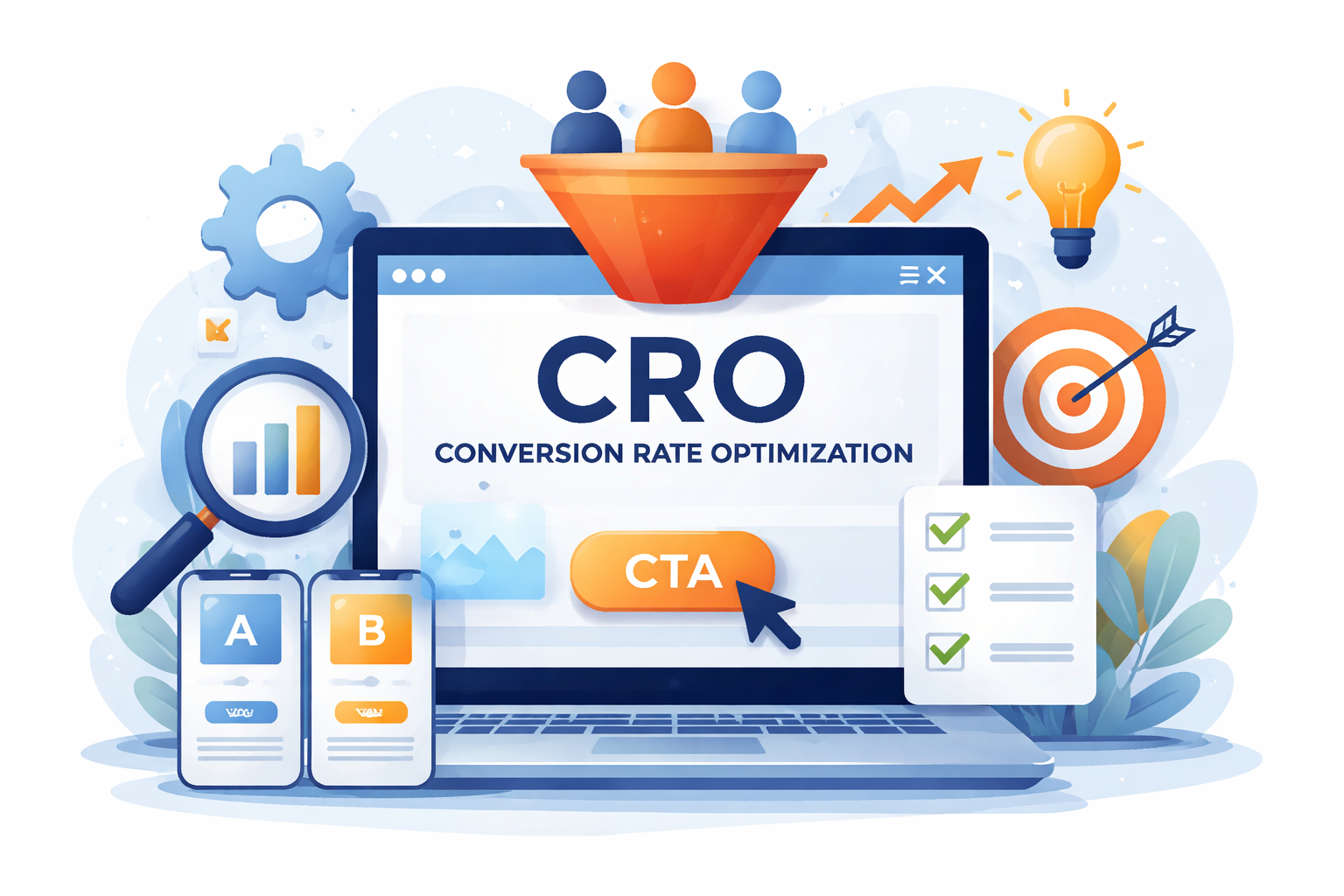
Conversion rate optimization (CRO) is a systematic process that increases the percentage of website visitors who take a desired action. Rather than simply driving more traffic, CRO focuses on refining the site itself to convert a higher share of existing visitors. Industry leaders define CRO as a process of generating ideas to improve site elements and validating those ideas through A/B or multivariate testing to boost conversions.
CRO uses data and user feedback to reduce friction, enhance the user experience and guide visitors toward completing goals such as submitting a lead form, making a purchase or subscribing to a newsletter. By continuously testing and tweaking elements like headlines, layouts, colors and copy, businesses can transform existing traffic into revenue.
Conversions and the Conversion Rate Formula
A conversion occurs when a visitor takes the desired action on your site – such as making a purchase, submitting a contact form, downloading a resource or signing up for a newsletter.
The conversion rate tells you the efficiency of your website in turning visitors into customers. It is calculated by dividing the number of conversions by the total number of visitors and multiplying by 100 to express the result as a percentage. For example, if 181 visitors make a purchase out of 12,355 site visitors, the conversion rate is 181 / 12,355 × 100 ≈ 1.46%.
Many industries consider conversion rates between 2% and 5% to be good. If your rate is below that range, you likely have room to optimize.
Why CRO Matters to Your Business
Investing in CRO yields several benefits:
Maximizes ROI from existing traffic – Instead of spending more on advertising to attract new visitors, CRO squeezes more value from the visitors you already have, improving return on investment.
Improves user experience – Eliminating friction and making it easy for users to achieve their goals increases satisfaction, reduces bounce rates and encourages repeat visits.
Relies on data, not guesswork – Testing and analytics reveal which changes actually improve performance, reducing the risk of decisions based solely on intuition.
Enhances customer insights – As you analyze user behavior and test different elements, you learn what resonates with your audience, which helps refine overall marketing and messaging.
Drives sustainable growth – Improving conversion rates builds a strong foundation that continues to pay dividends, making it easier to scale your business without dramatically increasing advertising spend.
Signs You Need Conversion Rate Optimization

How do you know when it’s time to focus on CRO? Here are common signals:
High traffic but low sales or leads – A steady stream of visitors with minimal conversions is the clearest sign that your user experience needs work.
High bounce rates or cart abandonment – People leave quickly or abandon their shopping carts, indicating they encountered friction.
Large gaps in your sales funnel – Analytics show users dropping off at specific steps, such as filling in a form or clicking a button.
User complaints or confusion – Customers send feedback that your site is confusing or they can’t find what they need.
Outdated or unresponsive design – Websites that aren’t mobile‑friendly or load slowly deter visitors; a mobile-first approach is now essential.
If these issues sound familiar, implementing a structured CRO process can help turn things around.
The Conversion Rate Optimization Process
CRO isn’t a one‑time project; it’s an ongoing, data‑driven process. A simple framework includes the following steps:
Identify your conversion goals. Define what actions you want visitors to take – purchases, form submissions, downloads, etc. This clarity ensures you focus on optimizing for meaningful results.
Analyze your current funnel. Use analytics tools (e.g., Google Analytics, heatmaps, user recordings) to see where visitors drop off. Identify high‑traffic or underperforming pages.
Gather user feedback. Surveys, reviews and on‑page feedback tools reveal pain points, confusing elements or reasons for abandonment.
Develop hypotheses for improvements. Based on data and feedback, come up with ideas for changes that might improve conversions (e.g., simplifying a form or changing CTA placement).
Prioritize and test. Focus on the most impactful pages first and test one change at a time using A/B or multivariate testing. Ensure tests run long enough to reach statistical significance.
Analyze results and implement winners. Review the data to determine which variation performs better; implement the winning changes sitewide.
Iterate continuously. CRO is ongoing – keep testing new ideas and revisiting pages as you gather more insights and your business goals evolve.
Following this structured process helps ensure that your changes are based on evidence rather than guesswork.
Proven CRO Techniques and Best Practices
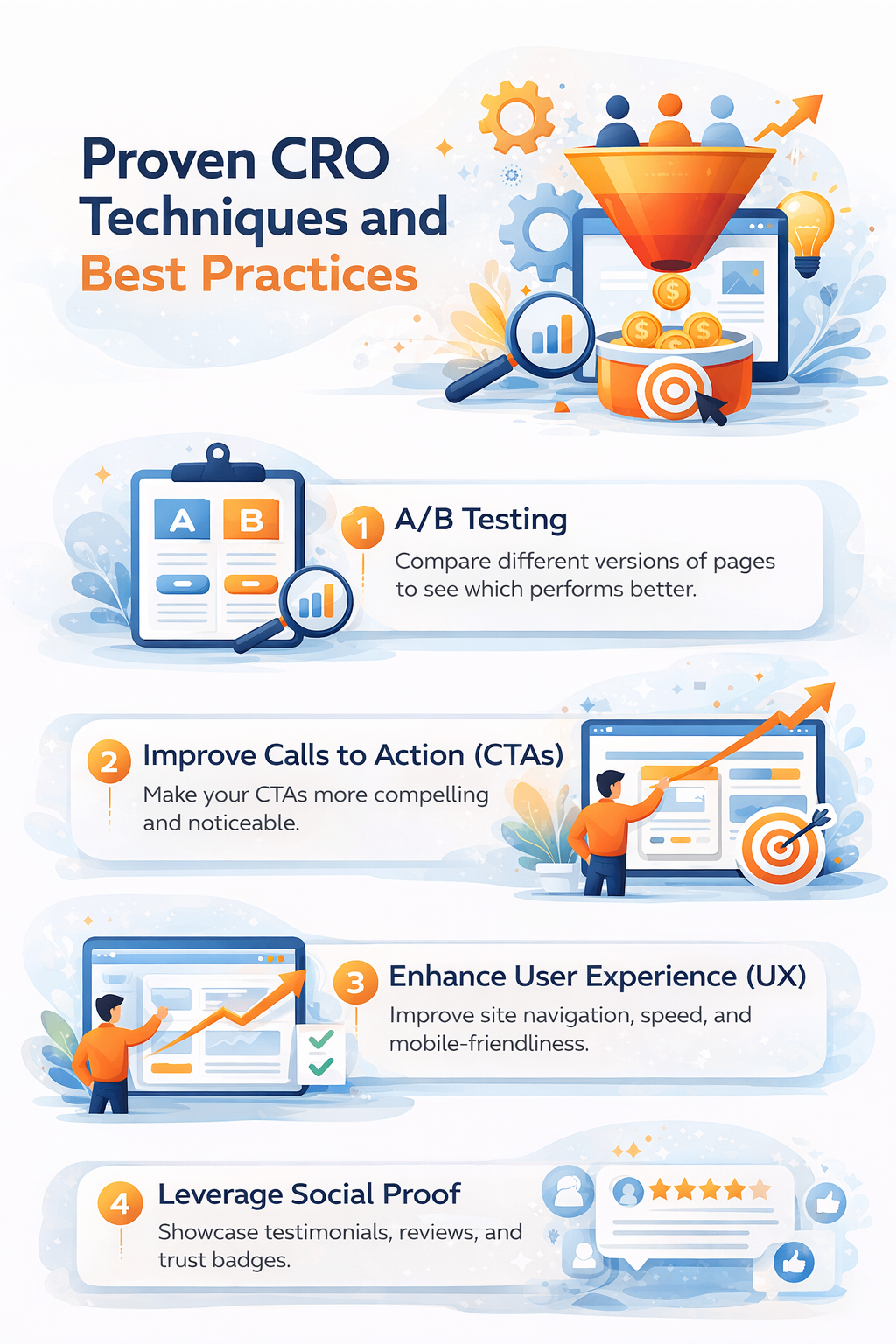
Optimizing your conversion rate involves many tactics. Below are proven practices to incorporate into your strategy.
1. A/B and Multivariate Testing
A/B testing, also called split testing, compares two versions of a page or element to see which performs better. Multivariate testing examines multiple variables (like headline, image and CTA) at once. Both approaches remove guesswork by providing empirical evidence of what works. When running tests:
Formulate clear hypotheses. For example: “Changing the CTA color from blue to orange will increase clicks by 15%.”
Focus on high‑traffic pages first. Homepages, product pages and landing pages yield data quickly.
Run tests long enough to ensure significance. Aim for at least a full business cycle or a minimum of 350–400 conversions per variant.
Document your learnings. Keeping a log of hypotheses, results and takeaways helps build a knowledge base for future tests.
2. Strategic Call‑to‑Action (CTA) Optimization
CTAs are the gateways to conversion. Optimizing copy, design and placement can produce big gains. Focus on:
Use first‑person, action‑oriented language. Phrases like “Get My Free Guide” outperform generic text.
Make CTAs visually prominent. Use contrasting colors, sufficient white space and sizes that are easy to tap on mobile devices.
Highlight benefits. Instead of “Submit,” use language that conveys value, like “Start Your Free Trial”.
Optimize placement. Place primary CTAs above the fold and repeat them at logical decision points for longer content.
Test variations. Continuously experiment with button text, color, size and positioning to discover what resonates with your audience.
3. Improve User Experience and Reduce Friction
User experience (UX) is central to CRO. A smooth, enjoyable journey encourages visitors to take action. Key tactics include:
Streamline navigation. Make it easy to find information with clear menus, internal links and search functions.
Simplify forms. Reduce fields to the essentials; each additional field can significantly decrease conversions.
Use clear headings and bullet lists. Break up text for easy scanning and highlight key information.
Add trust signals. Display customer testimonials, reviews, case studies, security badges or money‑back guarantees. These reassure users that your business is credible.
Provide social proof. Include real customer quotes or statistics; even small endorsements can boost trust.
Leverage personalization. Tailor messaging and offers based on user behavior or demographics to create a more relevant experience.
4. Page Load Speed and Performance Optimization
Fast load times are essential. Users expect pages to render almost instantly. Research highlights that even small delays cause higher bounce rates and lower conversion rates. To improve performance:
Aim for under two seconds. Strive for pages to load fully within two seconds.
Use tools like Google PageSpeed Insights to identify bottlenecks and fix them.
Optimize images. Compress images and adopt efficient formats (e.g., WebP), and implement lazy loading so images outside the viewport load later.
Streamline code. Minify CSS and JavaScript, defer non‑critical scripts and reduce HTTP requests.
Leverage caching and content delivery networks (CDNs). Serve static files from servers closer to your users to reduce latency.
5. Mobile‑First Responsive Design
More than half of web traffic now comes from mobile devices. A mobile‑first approach designs for small screens first and scales up for larger devices. Key principles include:
Design for touch. Make interactive elements large enough for easy thumb tapping (at least 44×44 pixels).
Simplify navigation. Use mobile‑friendly menus like hamburger or “priority+” layouts to maintain clarity on small screens.
Streamline forms. Reduce form fields and use auto‑fill where possible to minimize typing.
Integrate mobile features. Features like click‑to‑call, map links and mobile wallets make it convenient for users to convert.
Test on real devices. Browser emulators can’t replicate real‑world performance; always test your site on various phones and tablets.
6. Clarify Your Value Proposition and Messaging
A compelling value proposition immediately tells visitors what you offer, why it matters and why they should choose you. It should be concise, benefit‑driven and placed prominently on your site. Studies have shown that a clear, benefit‑oriented value proposition can dramatically lift conversions; companies have achieved improvements ranging from 26% to over 100% by refining their messaging.
Tips for crafting a strong value proposition:
Place it above the fold. Ensure your main benefit is visible without scrolling.
Focus on outcomes, not features. Describe what your product does for customers rather than just listing features.
Use the 5‑second test. Ask someone unfamiliar with your site to look at it for five seconds and then explain what you offer; if they can’t, your messaging isn’t clear enough.
Speak your customers’ language. Avoid jargon and use words your target audience uses.
7. Use Analytics and Heatmaps for Insight
CRO depends on understanding user behavior. Tools such as Google Analytics, Mixpanel, Hotjar or Crazy Egg allow you to monitor:
Traffic sources and user flow – See which channels drive visitors and how they navigate your site.
Bounce and exit rates – Identify pages where visitors leave and investigate why.
Heatmaps and session recordings – Visualize where people click, scroll and move their mouse. Heatmaps help you pinpoint areas of interest and neglect.
Form analytics – Discover which fields cause abandonment and optimize accordingly.
Data insights highlight hidden problems and opportunities that might not be obvious otherwise.
8. Personalization and Segmentation
Tailoring content and offers based on user behavior, demographics or previous interactions can significantly improve conversion rates. For example, showing returning customers a custom greeting and product recommendations speeds the path to purchase. Segment your audience by factors such as location, device type or referral source and test different messaging for each segment.
9. Leverage Social Proof and Trust Signals
People are more likely to act when they see others have had positive experiences. Add testimonials, case studies, reviews and industry badges throughout your site to build trust. Display star ratings and logos of well‑known clients or partners to signal credibility. A money‑back guarantee or secure checkout seal can further reassure hesitant buyers.
Integrating CRO with Your Digital Marketing Strategy
CRO doesn’t operate in isolation; it amplifies the results of your other marketing channels:
SEO – CRO improves metrics like dwell time and bounce rate, which can positively affect organic rankings. If you’re investing in professional on‑page SEO optimization, pairing it with CRO ensures the additional organic traffic converts.
PPC Advertising – Since you pay for each click, maximizing conversions via CRO lowers your cost per acquisition. Our PPC management services ensure ad campaigns deliver qualified traffic while CRO turns that traffic into customers.
Content Marketing – High‑quality content attracts visitors; CRO turns those readers into leads. Investing in content creation services for blogs and resources provides valuable material for testing different CTAs and offers.
Social Media Advertising – Ads on platforms like Facebook or Instagram bring targeted visitors; CRO ensures landing pages align with ad messaging and encourage action. Our social media ads team can craft campaigns while CRO helps you capitalize on the traffic.
Website Design and Development – A well‑designed site sets the foundation for conversions. Our website development services create user‑friendly, mobile‑responsive sites primed for CRO.
By aligning CRO with other marketing efforts, you create a cohesive funnel that attracts, engages and converts visitors.
When to Seek Professional Help
CRO can feel overwhelming if you’re new to it or lack dedicated resources. Consider partnering with experts when:
You lack internal resources – Running tests, analyzing data and implementing changes requires time and expertise.
Your site has significant technical or design issues – A professional can identify and fix deeper issues, such as website speed, mobile responsiveness or poor architecture.
Your conversion rate is far below industry benchmarks – A specialized agency can diagnose why and implement targeted fixes.
At Orange SEO, we offer services that complement and enhance CRO efforts, from SEO and content creation to PPC and web development. Our integrated approach ensures your website not only attracts traffic but also turns visitors into customers. If you’re ready to improve your conversions, contact us for a consultation.
95% of Your Website Visitors Will NEVER Buy Video:
Frequently Asked Questions About CRO
What’s the difference between CRO and SEO?
SEO focuses on increasing the quantity and quality of traffic to your website through organic search results. CRO focuses on increasing the percentage of visitors who take a desired action once they arrive. Both work together: SEO brings people to your site, and CRO ensures those visitors convert.
How long does it take to see results from CRO?
CRO is an ongoing process. Small changes like updating copy or button colors can yield quick wins within a few weeks. Larger design or user‑experience changes may take longer to plan, test and measure. Consistent testing and iteration over several months produce the best long‑term results.
Do I need a lot of traffic to run CRO tests?
You don’t need millions of visitors, but tests require enough traffic to reach statistical significance. Focus first on high‑traffic pages or campaigns. If your website has low traffic, make larger changes based on best practices and gather qualitative feedback until you have more data for testing.
Are pop‑ups and banners good for CRO?
Pop‑ups, slide‑ins and banners can help capture leads or promote offers when used sparingly and strategically. Ensure they are relevant to the visitor’s intent and easy to close. Test different timings and designs to find the right balance between visibility and user experience.
What tools do I need for CRO?
Start with tools like Google Analytics for data, Hotjar or Crazy Egg for heatmaps and session recordings, Google Optimize or Optimizely for A/B testing, and survey tools like Survicate or Typeform to collect user feedback. As you scale, invest in more advanced platforms that integrate analytics, testing and personalization.
What’s considered a “good” conversion rate?
Conversion rates vary widely by industry, product and traffic source. Research indicates that general ecommerce conversion rates between 2% and 5% are considered good. Use this as a guideline but focus on continuous improvement rather than chasing a specific number.
Can CRO improve my paid advertising results?
Absolutely. By testing landing pages, headlines and form layouts, you can lower your cost per conversion and increase the return on ad spend. Combining CRO with professionally managed campaigns – such as our PPC services – ensures each click has the highest chance of converting.
Does CRO help with mobile traffic?
Yes. A mobile‑first responsive design is a core CRO tactic. Optimizing for mobile ensures your site is easy to use on phones and tablets, which is critical because mobile traffic continues to grow.
Is CRO a one‑time fix?
No. User behavior, technology and competition change over time. Continuous testing and iteration keep your site relevant and performing at its best. Think of CRO as a routine part of your digital strategy rather than a project with a fixed end.