
Quantum Computing + LLMs: The Road to Superintelligence and the End of Traditional Search as We Know It
For the past several years, artificial intelligence has advanced at a pace few industries have ever experienced. Large Language Models (LLMs) can already write, reason, plan, analyze, code, and converse at near-human levels in many domains.
But what we are seeing today is still only the beginning.
The next major inflection point isn’t just “better AI models.”
It’s quantum computing combined with LLMs—a convergence that has the potential to unlock a form of computation so powerful that it fundamentally reshapes search engines, AI chat platforms, digital marketing, and how humans access knowledge.
In this article, we’ll break down:
What quantum computing actually is (in plain English)
Why combining quantum computing with LLMs could lead to superintelligence
Real-world examples of the new digital landscape we’re heading toward
What Is Quantum Computing (And Why It’s Different from Regular Computing)?
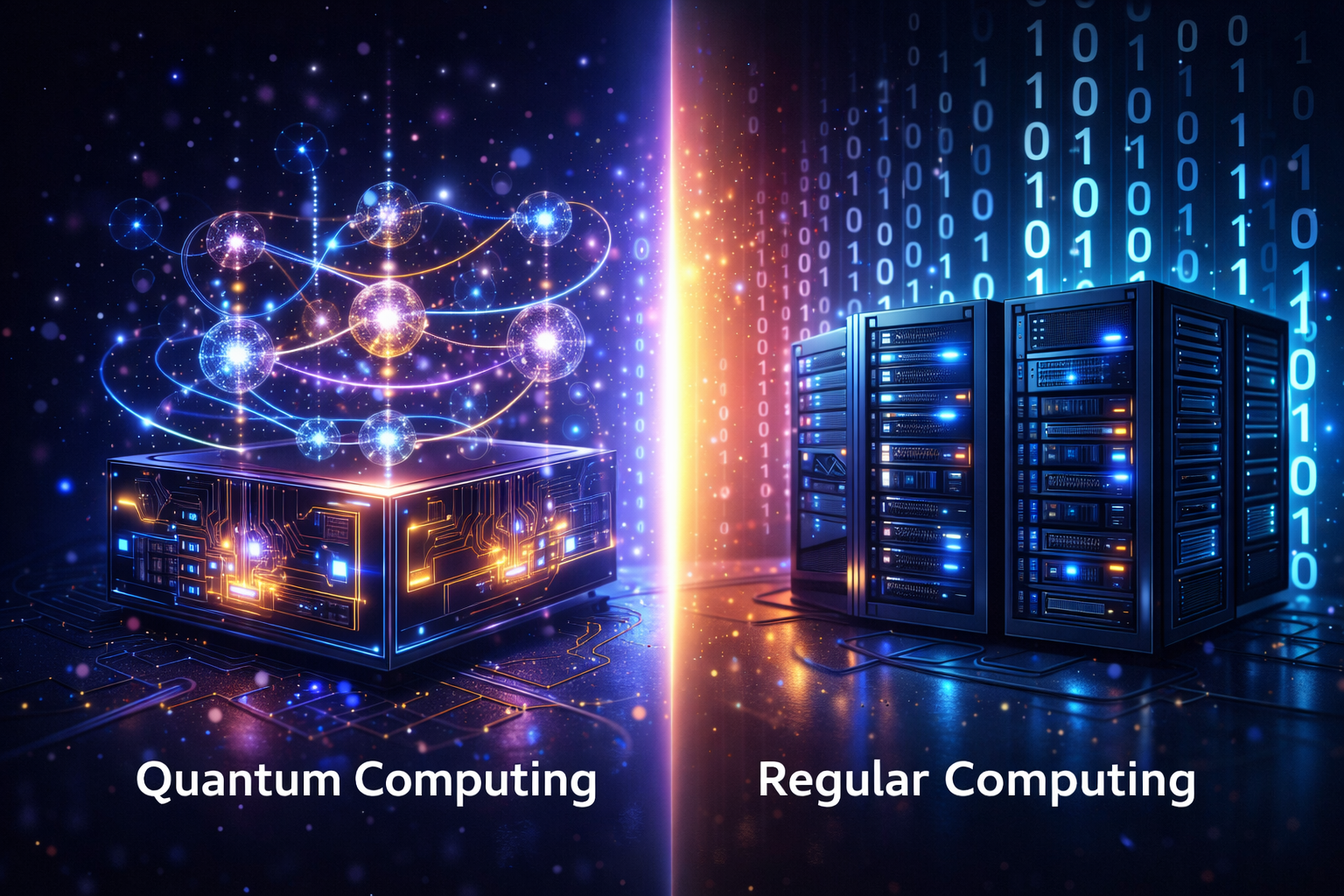
Traditional computers use bits.
Each bit is either:
0
1
Everything your laptop, phone, or server does is built on billions of these on/off switches.
Quantum computers use qubits.
Qubits behave differently because they leverage principles of quantum physics:
Superposition – A qubit can represent 0 and 1 at the same time
Entanglement – Qubits can become linked so the state of one instantly affects another
Interference – Probabilities can reinforce or cancel each other
Instead of checking one possibility at a time, quantum computers explore massive numbers of possibilities simultaneously.
That means certain types of problems that would take classical computers thousands (or millions) of years can theoretically be solved in seconds or minutes.
Why Quantum Computing Matters for AI
Modern LLMs already require enormous computational power. Training frontier models consumes:
Vast GPU clusters
Massive energy resources
Complex optimization processes
Even with all this hardware, today’s models still rely on classical computing limitations.
Quantum computing changes that equation.
With quantum acceleration:
Model training could become exponentially faster
Larger architectures become feasible
More complex reasoning paths can be evaluated instantly
Entirely new learning paradigms become possible
In short:
Quantum computing doesn’t just make AI faster.
It unlocks new forms of intelligence that classical machines cannot efficiently reach.
The Moment Quantum Computing Meets LLMs
Imagine combining:
LLMs’ ability to reason, understand language, and generate insight
Quantum computing’s ability to explore enormous solution spaces simultaneously
You don’t just get a better chatbot.
You get something closer to superintelligence:
Systems that test billions of reasoning paths at once
Models that simulate outcomes before responding
AI that optimizes itself in near-real time
This is where AI moves from “predictive text” to strategic cognition.
Why Google Is One of the Leaders in Quantum Computing
Among global technology companies, Google stands in a unique position:
Massive capital reserves
Proprietary hardware infrastructure
Deep AI research teams
Dedicated quantum division: Google Quantum AI
Google already demonstrated a major milestone when its quantum processor performed a calculation in minutes that would have taken classical supercomputers thousands of years.
Beyond raw research, Google also controls:
The world’s dominant search engine
A leading LLM ecosystem (Gemini)
The largest advertising platform on Earth
That combination matters.
Quantum breakthroughs won’t exist in isolation.
They will be integrated directly into:
Search
AI assistants
Ads systems
Cloud services
Few companies can deploy that scale as fast as Google.
Other major players pushing quantum research include:
But Google’s ownership of search gives it a structural advantage in reshaping information access.
How Quantum-Enhanced AI Changes Search Forever
Traditional search today works like this:
You type a query
Google retrieves indexed pages
Algorithms rank results
You click and browse
Even with AI Overviews, this model still depends heavily on websites.
Quantum-powered AI enables a different paradigm:
The system doesn’t just retrieve information
It computes answers
Instead of pulling from static documents, AI will:
Simulate outcomes
Combine multiple knowledge domains
Generate original, context-aware responses
Search becomes a conversation with a reasoning engine, not a list of links.
The Shift from “Searching” to “Solving”
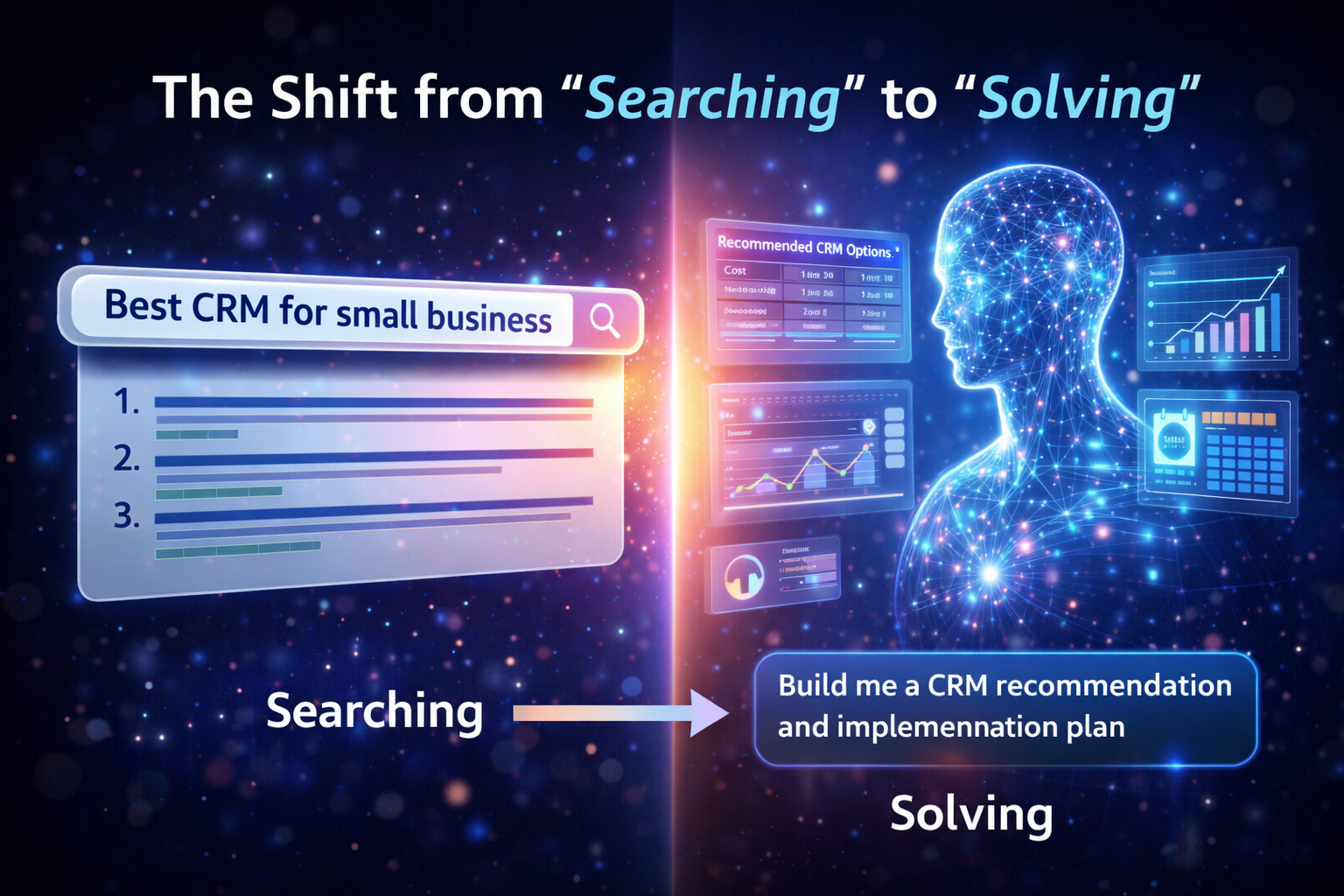
In the quantum + LLM world:
You won’t ask:
“Best CRM for small business”
You’ll say:
“I run a 12-person home services company, average deal size $3,500, want tighter sales follow-up, and integrate with QuickBooks. Build me a CRM recommendation and implementation plan.”
The AI will:
Simulate thousands of software stacks
Model cost vs. ROI scenarios
Output a tailored system design
No browsing required.
What Happens to Websites and SEO?
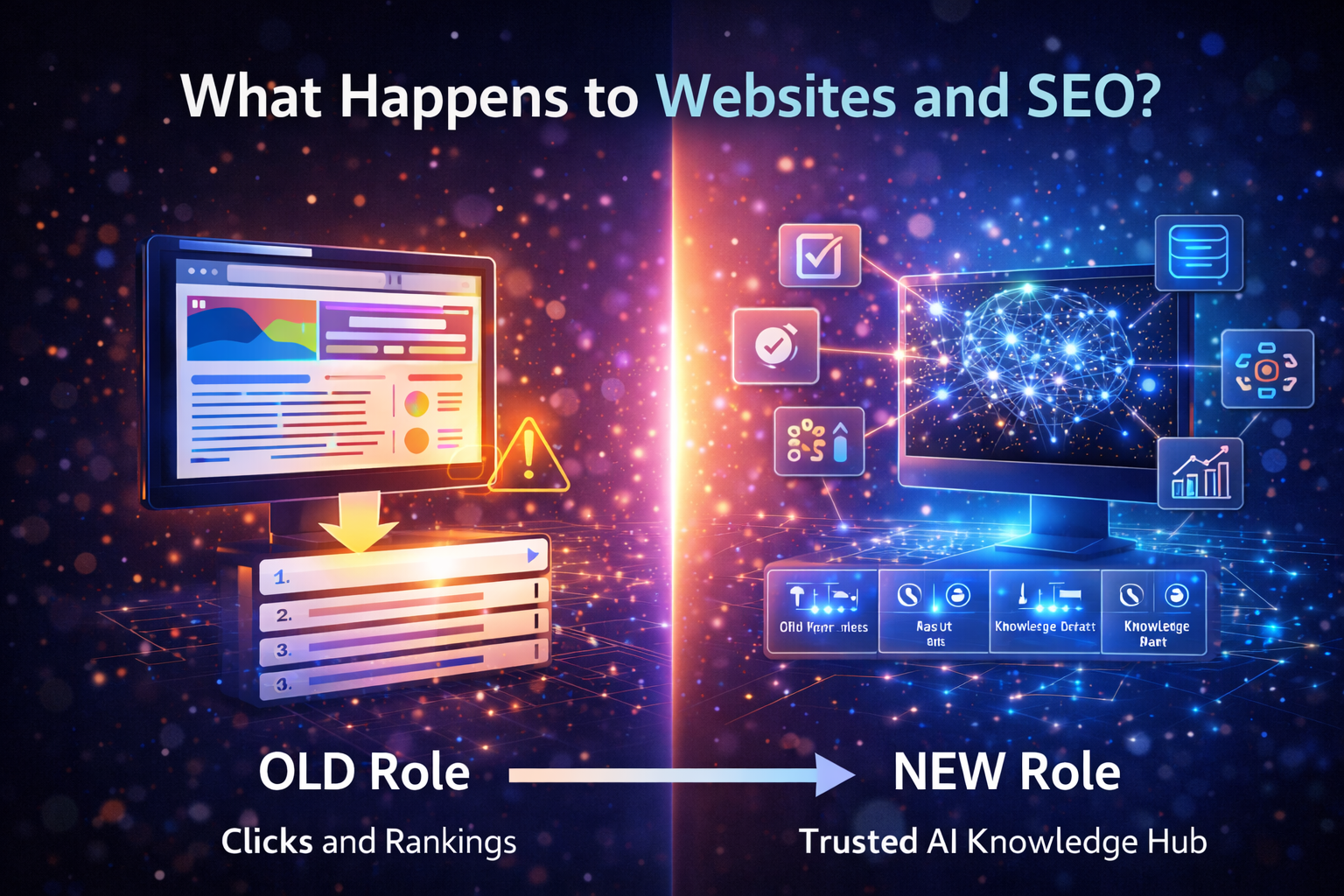
Websites don’t disappear.
But their role changes.
Instead of being the primary destination, websites become:
Structured knowledge sources
Verified authority repositories
Training signals for AI systems
SEO evolves into:
AI Visibility Optimization
Key focus areas:
Entity authority
Structured data
Clear topical depth
Machine-readable accuracy
Trust signals
Ranking #1 in blue links matters less than:
Being a trusted source AI consistently pulls from.
The New Digital Landscape: Specific Examples
Let’s look at what this future could realistically look like.
Example 1: Instant Business Strategy Generation
You ask:
“Build a 12-month marketing plan for a dental practice in Miami with a $15k/month budget.”
Quantum-LLM system:
Simulates thousands of market scenarios
Evaluates competitor strategies
Predicts channel performance
Outputs:
Budget allocation
Campaign roadmap
Content calendar
Expected ROI
In seconds.
Example 2: Hyper-Personalized Shopping
Instead of browsing product pages:
“Find me the best standing desk under $1,200 that fits my height, room size, posture issues, and shipping timeline.”
AI:
Simulates ergonomics
Evaluates product specs
Cross-references reviews
Returns one optimal choice
E-commerce becomes recommendation-driven, not catalog-driven.
Example 3: Autonomous Marketing Execution
You say:
“Launch lead generation for my HVAC business in Tampa.”
AI:
Builds landing pages
Writes ad copy
Launches Google Ads
Monitors performance
Adjusts budgets
Tests messaging
With minimal human input.
Agencies evolve from execution vendors into strategy and oversight partners.
Example 4: Predictive Healthcare Guidance
You input:
Symptoms
Medical history
Genetic data
AI:
Simulates treatment paths
Flags risk scenarios
Suggests next steps
Doctors remain essential—but AI becomes a powerful diagnostic copilot.
The Economic Impact: Winner-Take-Most Dynamics
Quantum-AI systems will be extremely expensive to build and operate.
This favors companies with:
Massive capital
Cloud infrastructure
Data access
Distribution platforms
Companies like Google gain compounding advantages.
Smaller businesses won’t own quantum systems—but they’ll build on top of them.
Just like today:
You don’t own Google’s servers
You leverage Google’s platform
Same pattern, larger scale.
What Businesses Should Do Right Now
Even though quantum AI isn’t public yet, preparation matters.
Smart companies should:
Build strong brand entities
Publish deep, authoritative content
Structure data clearly
Invest in AI-readable websites
Focus on topical authority, not keyword stuffing
These actions future-proof visibility across:
Search engines
AI chats
Recommendation systems
The Big Picture
Quantum computing + LLMs represents more than incremental progress.
It represents:
The shift from retrieving information
To computing intelligence
Search becomes reasoning.
Websites become knowledge infrastructure.
AI becomes a decision-making partner.
The businesses that adapt early will not just survive this transition.
They’ll dominate it.
Quantum AI: The End of Google Search? Video:
Frequently Asked Questions (FAQ)
What is quantum computing in simple terms?
Quantum computing uses quantum bits (qubits) that can represent multiple states at once, allowing computers to solve extremely complex problems far faster than traditional computers.
How is quantum computing different from classical computing?
Classical computers process one calculation path at a time, while quantum computers evaluate many possible outcomes simultaneously using superposition and entanglement.
What are LLMs (Large Language Models)?
LLMs are AI systems trained on massive amounts of text data that can understand language, generate responses, summarize content, and perform reasoning tasks.
Why does combining quantum computing with LLMs matter?
Quantum computing could dramatically speed up training and reasoning for LLMs, enabling more advanced intelligence, deeper simulations, and faster decision-making.
Could quantum-powered AI lead to superintelligence?
Yes. The combination of massive parallel computation and advanced reasoning models could produce AI systems that outperform humans across many cognitive tasks.
How will quantum AI change search engines?
Search will shift from showing lists of links to directly generating computed answers, strategies, and recommendations in real time.
Will traditional SEO still matter?
Yes, but SEO will evolve toward entity authority, structured data, and being a trusted source that AI systems rely on.
What happens to websites in a quantum AI world?
Websites become authoritative knowledge hubs that train and feed AI systems rather than just ranking destinations for clicks.
How will AI chat platforms change?
AI chat will become more proactive, predictive, and capable of executing multi-step tasks rather than only answering questions.
Will small businesses be able to use quantum AI?
Yes. Most businesses will access quantum-powered AI through cloud platforms rather than owning quantum hardware.
Is quantum computing available to the public yet?
Not at large scale. Current systems are primarily used for research, but commercial access is expected to grow over time.
How should businesses prepare today?
Focus on building brand authority, publishing high-quality content, structuring data clearly, and optimizing websites for AI readability.
Sources
Google Quantum AI
https://quantumai.google/Google AI Blog
https://ai.googleblog.com/IBM Quantum Computing
https://www.ibm.com/quantumMicrosoft Azure Quantum
https://azure.microsoft.com/en-us/products/quantumNature – Quantum Computing & AI Research
https://www.nature.com/subjects/quantum-computingMIT Technology Review – Quantum Computing & AI Coverage
https://www.technologyreview.com/topic/quantum-computing/Stanford University Human-Centered AI Institute
https://hai.stanford.edu/OpenAI Research
https://openai.com/researchWorld Economic Forum – Quantum Technologies
https://www.weforum.org/topics/quantum-technology/