SEO · AI search · Search Console
Is your homepage still the front door to your business? For years, most people who found a company on Google landed on its homepage first. New research suggests that is changing fast. A study of 110 websites found a broad homepage organic traffic decline: about three in four homepages got fewer clicks from Google this summer than they did a year earlier.
That sounds alarming, but it doesn't automatically mean those businesses are struggling. In many cases, people are still finding the brand. They are just arriving somewhere else, such as a service page, a product page, a pricing page or a helpful guide.
The takeaway: Your homepage is no longer the only way in. Every important page on your site now needs to work as a first impression, and your reports should look at the whole site, not just homepage clicks.
What the study measured, and what it can't tell us
The research, published by Search Engine Land in November 2026, looked at data from Google Search Console, Google's free tool that shows how a website performs in Google search. It compared homepage results from July to September 2026 (the third quarter, or Q3) with the same three months in 2025.
The 110 sites came from six industries:
- Ecommerce (online stores): 34 sites
- SaaS (companies that sell software by subscription): 25 sites
- Education and information: 19 sites
- Finance: 14 sites
- Logistics (shipping and delivery): 10 sites
- Healthcare: 8 sites
The study focused on clicks, meaning the number of times someone clicked a Google result and landed on the homepage. It left out impressions (the number of times a page appeared in search results, whether or not anyone clicked) for the year-over-year comparison. That's because Google changed how impressions were counted in 2025, which would have made the comparison unreliable. Clicks weren't affected.
Before we get into the numbers, here are the limits, stated plainly:
- It's a small sample. 110 sites is useful, but it doesn't represent every website. Healthcare had only eight sites, so treat that result as a rough signal.
- It's observational. The study shows what happened, not why. It does not prove that Google's AI features caused the drop.
- It uses medians. The median is the middle result when all sites are lined up from best to worst. The study used it because a few very large sites would have skewed a simple average.
- The AI data is new. Google's report on AI search appearances only became available to all sites in 2026, so there's no year-earlier figure to compare against.
With that in mind, the patterns are still worth paying attention to.
The homepage organic traffic decline in numbers
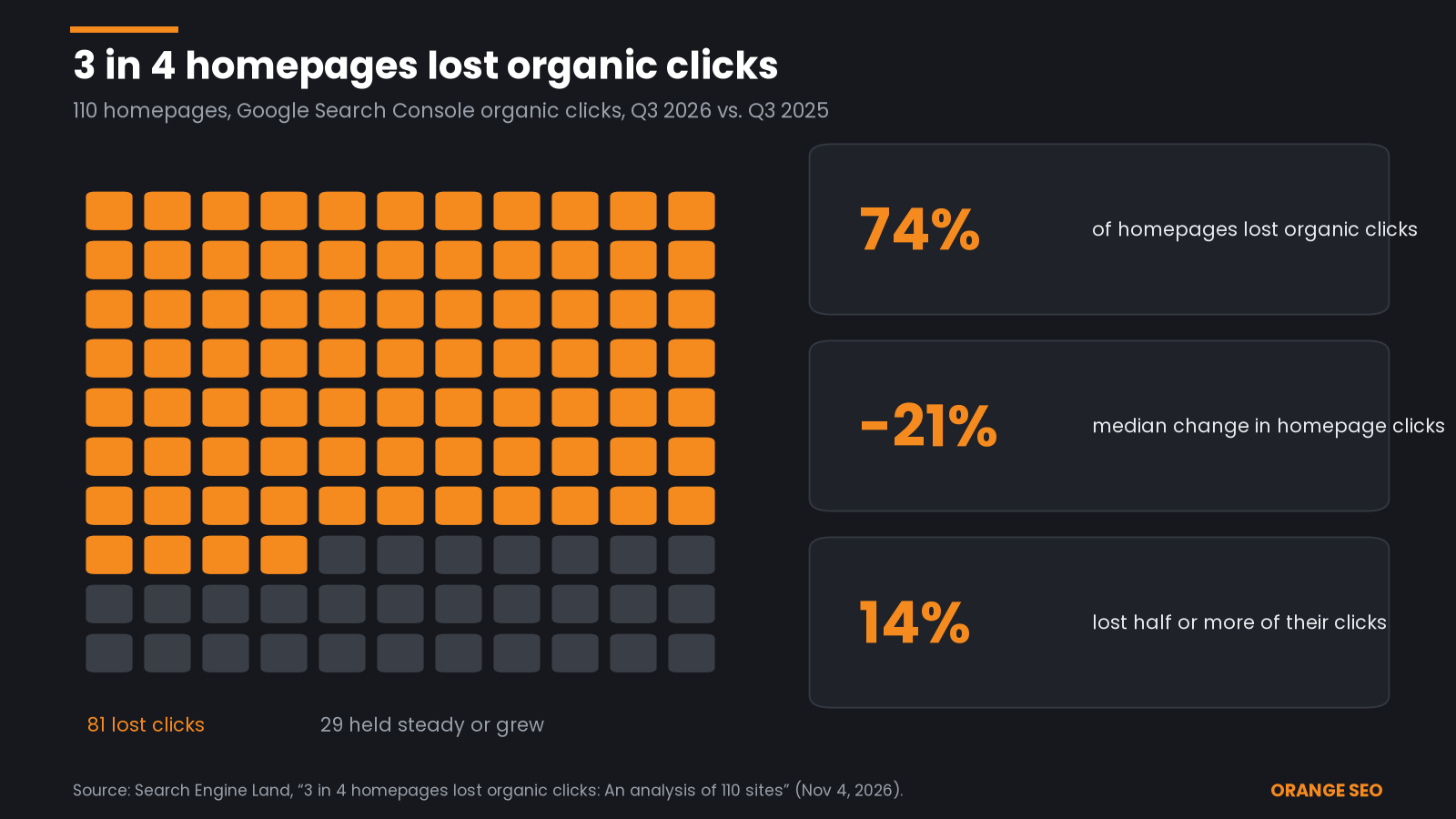
Here is the headline finding: 81 of the 110 homepages (74%) lost organic clicks. "Organic" simply means the unpaid results on Google, not ads. The median homepage saw a 21% decline in clicks.
The drops weren't all dramatic. The middle half of sites landed somewhere between a 37% loss and a 3% gain. Only 15 of the 110 homepages (14%) lost half or more of their clicks.
Source: Search Engine Land
That spread matters. If only a few sites had big losses, you'd suspect site-specific problems like a botched redesign or lost rankings. But when nearly three out of four homepages decline at the same time, it points to a broader shift in how people search.
One methodology detail helps here: across all 110 homepages, total clicks fell 16%, but only 7% without the four largest sites. Big brands moved the totals, which is why the median is the fairer number.
Homepage clicks decline by industry: SaaS hit hardest
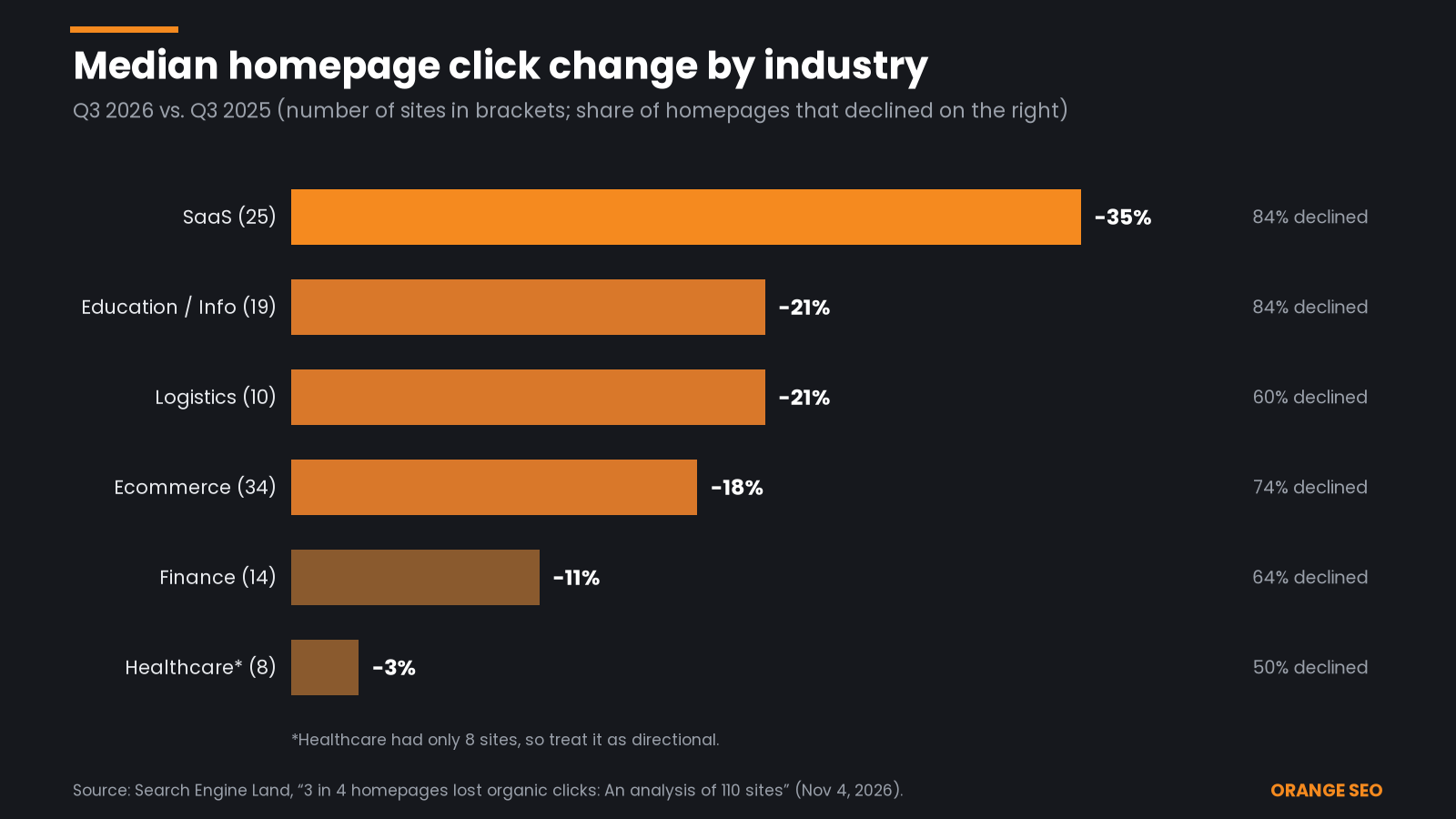
Not every industry saw the same thing. Here is how the median homepage click change broke down:
| Industry | Sites | Median click change | Share of homepages that declined |
|---|---|---|---|
| SaaS | 25 | -35% | 84% |
| Education / information | 19 | -21% | 84% |
| Logistics | 10 | -21% | 60% |
| Ecommerce | 34 | -18% | 74% |
| Finance | 14 | -11% | 64% |
| Healthcare | 8 | -3% | 50% |
Source: Search Engine Land
SaaS took the biggest hit. 21 of 25 software homepages lost clicks, with a median drop of 35%. A likely reason is that software homepages often try to rank for broad category searches like "project management software" or "CRM software." People typing those searches usually want to compare options, and Google now often answers them with AI-written comparisons and "best of" lists instead of sending people to one company's homepage.
Education and information sites lost clicks just as often (84% declined), with a 21% median drop. These homepages have traditionally ranked for broad questions like "how to become a nurse," which Google's AI features now tend to answer right on the results page. Separate industry research has found AI Overviews show up far more often on informational searches than on shopping-style searches, which fits this pattern.
Finance and healthcare held up best, at -11% and -3%. They were still down overall, though, and with only 14 and 8 sites, those numbers should be read as rough signals rather than firm rules. Ecommerce sat in the middle at -18%.
The 57% finding: specific pages now win discovery
This is the part of the study we think matters most for business owners.
Google Search Console now includes a report that shows how often your pages appear in Google's AI search features, such as AI Overviews (the AI-written summary at the top of some results) and AI Mode (Google's chat-style search). The study used that report to see which page on each site appeared most often.
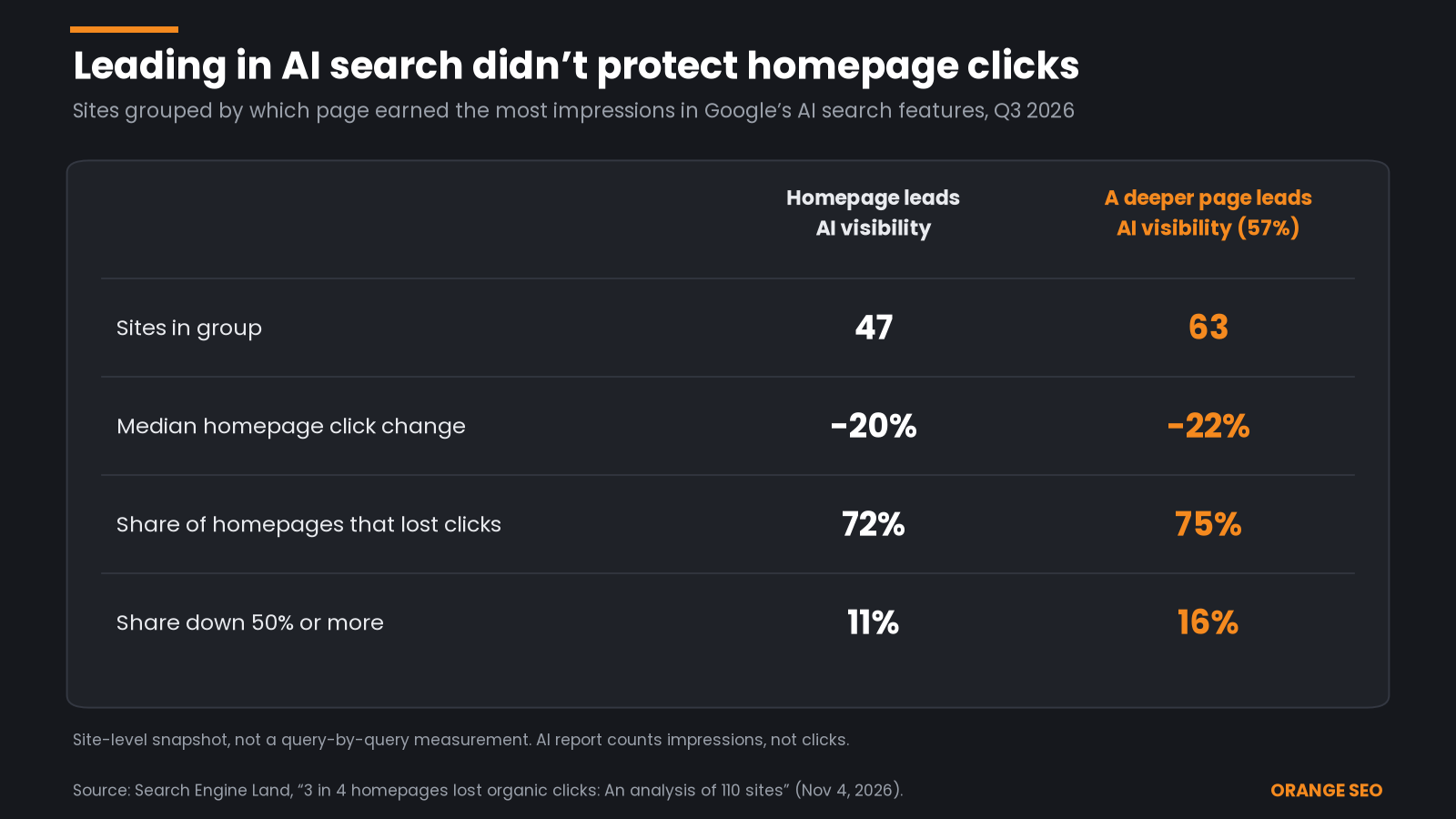
For 63 of the 110 sites (57%), the page with the most impressions in Google's AI search features was not the homepage. It was a product page, a pricing page, a service page or a resource like a guide.
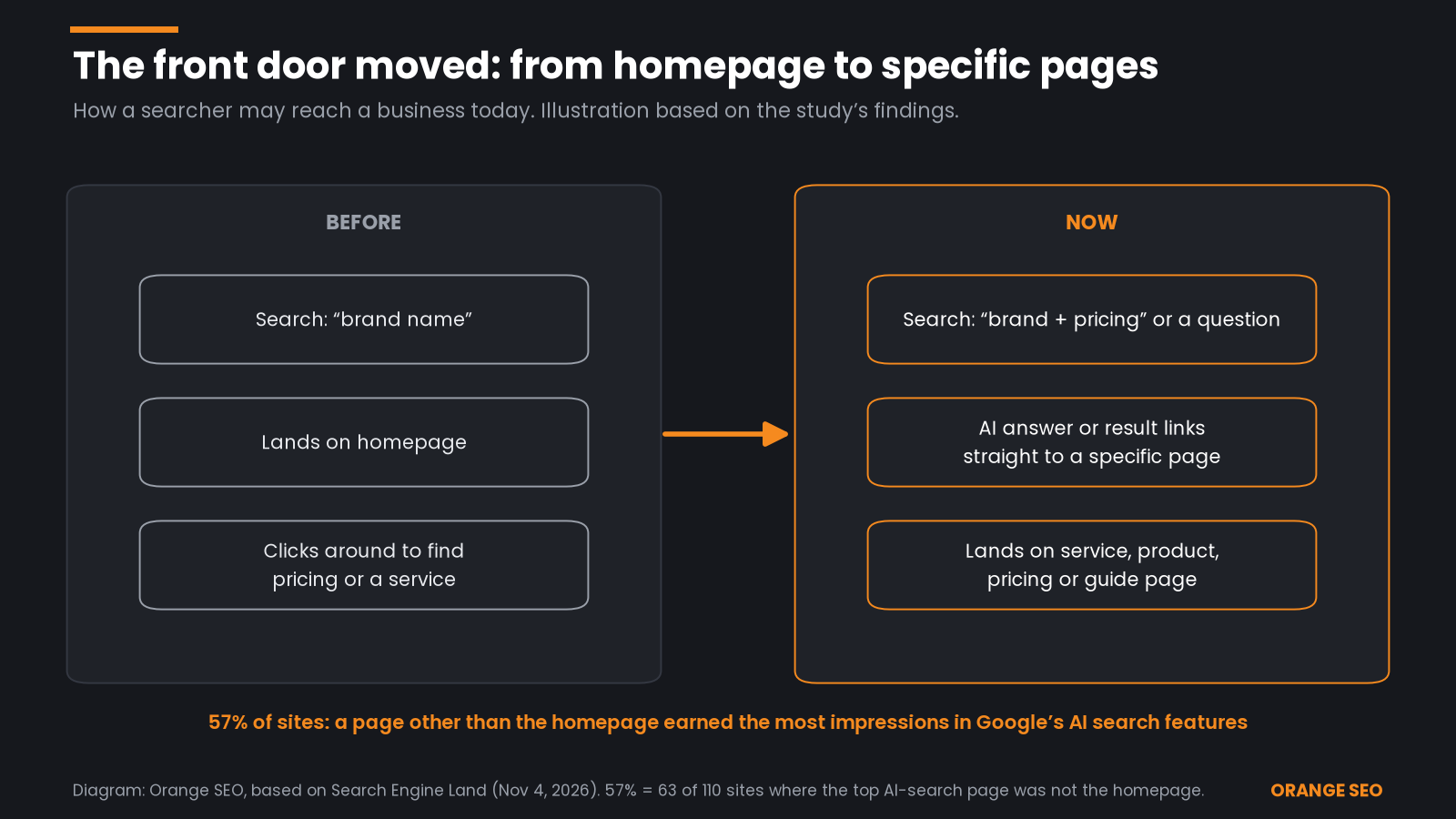
Diagram: Orange SEO, based on Search Engine Land
In plain terms: when Google's AI answers a question about a business, it usually points to the page that best answers that question, not the homepage.
Interestingly, being the page Google's AI shows most didn't protect homepage clicks. Sites where the homepage led in AI appearances saw a median click change of -20%. Sites where a deeper page led saw -22%. That difference is small.
Source: Search Engine Land
Two cautions here. First, this was a snapshot of which single page led each site, not a search-by-search measurement. Second, the AI report counts impressions, not clicks, so it can't tell us how much traffic those AI appearances sent. Still, other research suggests being cited is better than not: pages cited in an AI Overview drew clicks from about 2.1% of the people who saw them, against 0.9% for pages that weren't cited.
Why is this happening? Three likely explanations
The study can't prove a cause, and we won't pretend it does. But three explanations fit what the data shows.
1. AI answers point to the most specific page
AI Overviews and AI Mode build an answer and then link to the pages they used as sources. Those links tend to go to the page that matches the question, such as a pricing page for a pricing question or a how-to guide for a how-to question. A homepage, which tries to say a little about everything, is rarely the best match.
2. Brand searches are changing
Branded searches, meaning searches that include a company's name, are the homepage's main source of traffic. Across 10 sites in the dataset where this was checked, branded searches made up about 79.6% of homepage clicks.
But people are getting more specific. Instead of typing just the brand name, they type "brand pricing," "brand reviews," "brand alternatives" or "brand returns." Google then sends them straight to the page that answers that. At one software company in the study, the top three landing pages for those kinds of searches were all pricing pages, together drawing more than 8,000 clicks. The homepage wasn't even in the top 10.
On top of that, Google's AI summaries started appearing on far more branded searches in late September 2026, based on tracking data from SEO tool companies. Because that jump happened at the very end of the quarter, it barely shows up in this study. If your business gets most of its homepage visits from people searching your name, watch those numbers closely over the next few months.
3. More searches end without a click
Some lost homepage clicks don't go to another page at all. For simple questions like opening hours, a phone number or "what does this company do," Google can show the answer directly on the SERP (search engine results page, the page of results you see after searching). One 2026 study found that about 68% of U.S. Google searches ended without a click. Those quick, factual brand questions are exactly the ones homepages used to collect.
What to do about a homepage organic traffic decline
None of this means your homepage is dead. Its job has changed. It's becoming less of a discovery tool and more of a confirmation stop for people who already know you and want to check you out. Here's how to adjust.

Planning service pages that can stand on their own as a first impression.
Build and strengthen your service and product pages
If people are increasingly landing on specific pages, those pages need to do the work the homepage used to do. Each important service or product page should clearly explain what you offer, who it's for, what it costs (or how pricing works), and what to do next. Answer the real questions customers ask, in plain language. Our on-page SEO and website optimization work focuses on exactly this kind of page-level improvement.
Link from your homepage to the pages that matter
Internal links (links from one page on your site to another) help both visitors and Google understand which pages are most important. Make sure your homepage links clearly to your main service and product pages, and that those pages link sideways to related services and next steps. Every deep page is now a potential first impression, so none of them should be a dead end.
Check which pages actually win impressions in Search Console
In Google Search Console, open the Performance report, view it by page and sort by impressions and clicks. Then check the AI search performance report to see which pages appear most in AI features. A single service page or blog post may be doing more discovery work than your homepage.
It also helps to look at your impressions share by page, meaning what portion of your site's total impressions each page earns. If one page has a large share, give it extra attention: keep it current, make its call to action clear, and link it to related pages.
Track AI citations, not just clicks
Clicks from AI answers are only part of the picture. Keep an eye on whether Google's AI features, ChatGPT and other AI tools mention and link to your business. Our SEO and AI services and AI citation outreach are built around getting your pages cited as sources. For more on this, see our guide to becoming a source for AI answers.
Change what you report on
If you use homepage visits as a sign of brand health, it's time to update that. Better measures include:
- Branded clicks across the whole site, using the branded queries filter in Search Console
- Direct traffic in Google Analytics, which counts people who type your web address (though be careful: bots can inflate Direct traffic)
- Leads and sales from organic search across all landing pages, not only the homepage
Deeper pages may actually turn more visitors into customers, because someone who lands on your pricing page from a pricing search already knows what they want. Check conversion rates by landing page in Google Analytics before deciding that less homepage traffic means less business. Our post on how AI search is changing marketing attribution goes deeper on this.
Don't panic-delete or overhaul your homepage
A falling homepage number is not a reason to tear the page down or stuff it with keywords. Your homepage still matters for people who search your name, for trust and for directing visitors to the right place. Keep it clear, fast and well linked, and put your extra effort into the pages people are actually landing on.
Frequently asked questions
Why is my homepage getting fewer clicks from Google?
It may not be anything you did wrong. In this study, 74% of homepages lost clicks year over year. Likely reasons include AI answers linking to more specific pages, people searching your brand with extra words like "pricing" or "reviews," and more searches ending without a click. Check for site-specific problems too, such as a recent redesign or lost rankings.
Does a homepage traffic decline mean my business is losing customers?
Not necessarily. People may be finding you through other pages, or getting a quick answer from Google before contacting you. Look at branded clicks across your whole site and leads from all landing pages before drawing conclusions.
Did AI Overviews cause the homepage traffic decline?
The study doesn't prove that. It was an observational look at 110 sites, and it can't separate the effect of AI features from other changes in how people search. AI features are a likely factor, but not a confirmed cause.
Which industries saw the biggest homepage clicks decline?
SaaS (subscription software) homepages had the largest median drop at 35%, followed by education and information and logistics at 21%. Finance (-11%) and healthcare (-3%) held up best, though both had small samples.
How do I see which pages win AI search impressions?
In Google Search Console, open the Performance reports and look for the report covering Google's AI search features, then view results by page. Compare that list with your regular search results to see which pages Google relies on most.
Need help making every page a front door?
If your homepage traffic is slipping, the fix usually isn't the homepage. It's making sure your service and product pages are strong enough to win the search, earn the AI citation and turn the visit into a lead. Contact Orange SEO and we'll show you which pages are actually bringing people in, and how to make them work harder.
Sources
- Search Engine Land, "3 in 4 homepages lost organic clicks: An analysis of 110 sites" (Nov 4, 2026): https://searchengineland.com/homepages-lost-organic-clicks-analysis-500246
- Seer Interactive, AIO Impact on Google CTR: 2026 Update: https://www.seerinteractive.com/insights/aio-impact-on-google-ctr-2026-update
- SparkToro, In 2026, Less than One Third of Google Searches Still Send a Click: https://sparktoro.com/blog/in-2026-less-than-one-third-of-google-searches-still-send-a-click/
- Google Search Central, AI features and your website: https://developers.google.com/search/docs/appearance/ai-features