
Google updates · SEO · Search Console
Did your Google traffic jump or slide this month? The Google November 2026 core update is the most likely reason. It began rolling out on November 10, it's still finishing up, and it lands right before Black Friday, in the same week Google changed the AI model behind AI Mode. That makes this one of the trickiest updates in years to read correctly.
Below, we explain what this core update is, why your data may be misleading right now, and exactly how to tell whether your site was affected and what to do about it.
The short version: Don't make big website changes yet. Wait until Google says the rollout is complete, then wait one more week. Compare that week with the week before November 10, and account for holiday shopping, a known Search Console reporting gap and the AI Mode model change before you decide anything.
What is the Google November 2026 core update?
A core update is a broad change to the main systems Google uses to rank search results. It doesn't target any one website or penalize anyone. Instead, Google re-evaluates which pages best answer each search, so some pages move up and others move down.
Google's own comparison is a list of your 20 favorite restaurants. If you rewrote that list years later, new places would make the cut and some old favorites would slide. The ones that moved down aren't necessarily bad. Others simply earned the spot.
Here's what's confirmed about this update:
- Start: November 10, 2026, at 10:06 AM Pacific, per Google's Search Status Dashboard
- Scope: It applies globally and to all languages
- Timing: Google said the rollout "may take up to 2 weeks to complete"
- Status: As of the morning of November 23, the dashboard still listed it as active
- Context: It's Google's third core update of 2026, after March and May, and the eighth ranking update on the dashboard this year
Google described it as "a regular update designed to better surface relevant, satisfying content for searchers from all types of sites." It hasn't said what specifically changed, and it hasn't shared any new guidance for this update.
Why this core update is harder to read than usual
Most core updates are tricky to analyze. This one stacks four complications on top of each other.
1. Rollouts often run longer than two weeks
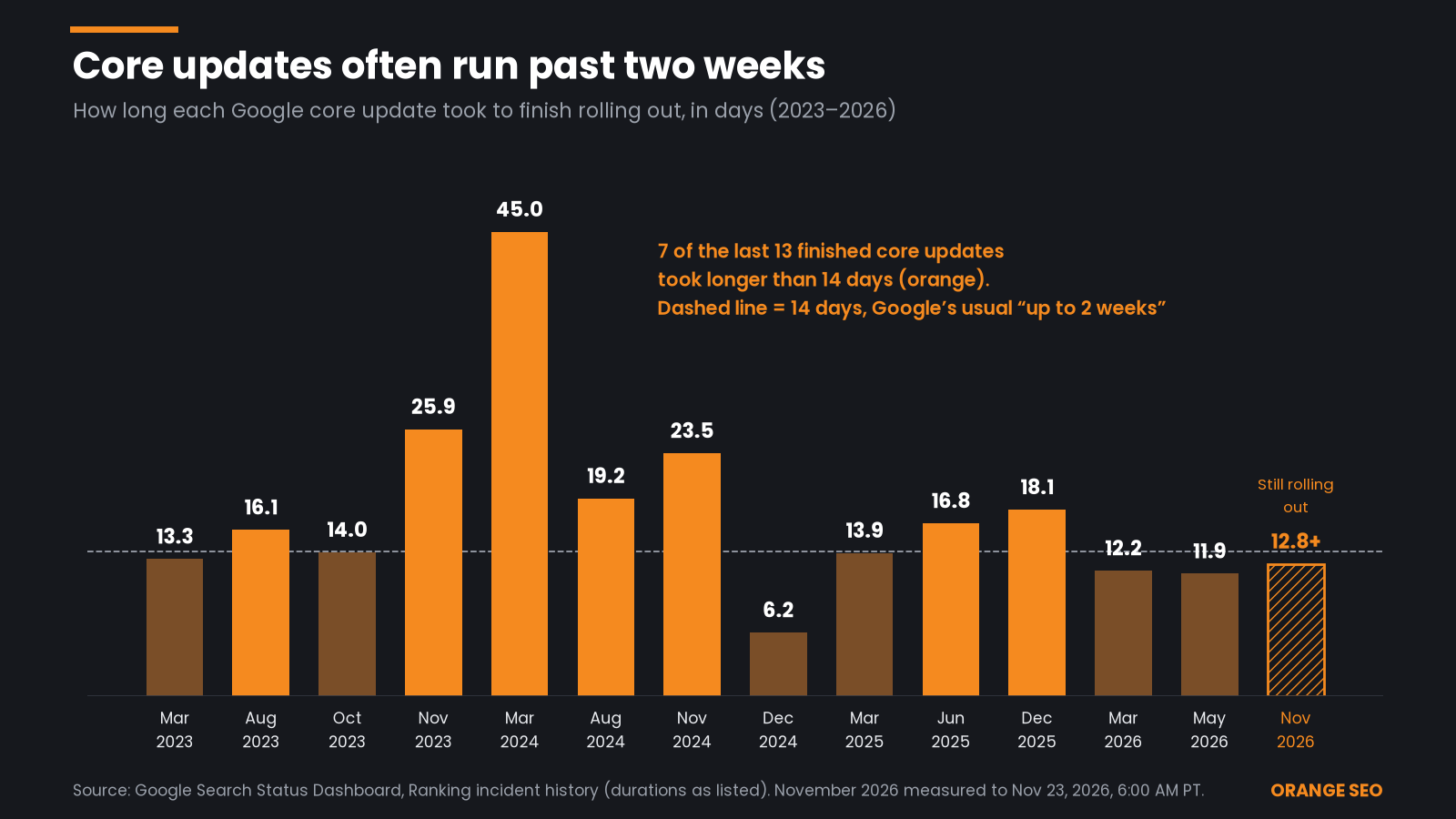
"Up to two weeks" is Google's usual estimate, not a promise. Looking back at every core update since 2023, more than half ran past 14 days.
Source: Google Search Status Dashboard
The two core updates earlier this year each finished in about 12 days. But the last two November core updates took nearly 26 days (2023) and about 23.5 days (2024). Until Google marks this one complete, assume rankings can still shift.
2. It overlaps the busiest shopping week of the year
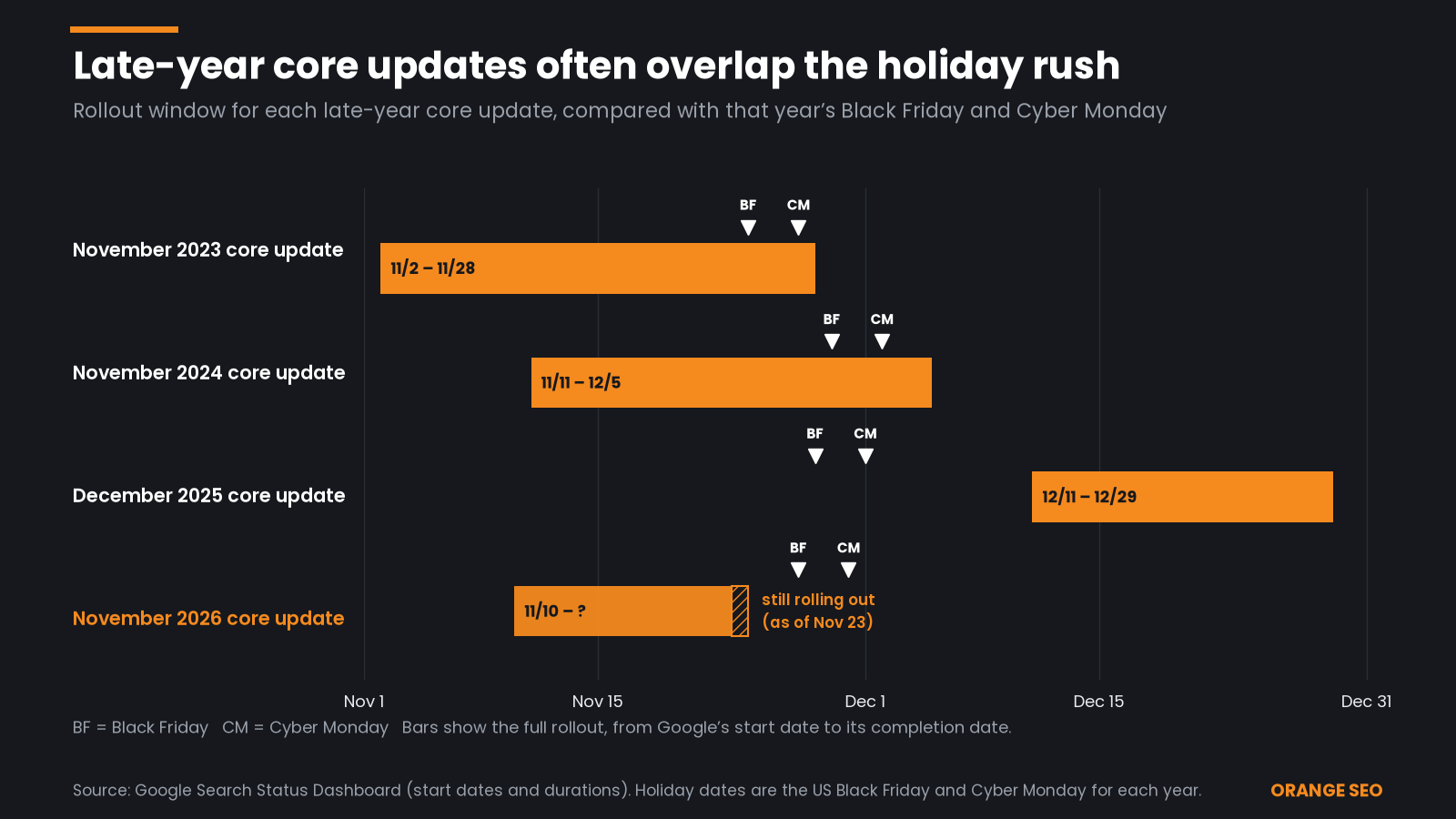
Black Friday is November 27 this year, and Cyber Monday is November 30. Even if the rollout ends on schedule, your "after" data will be full of holiday shopping behavior. That happened in 2023 and 2024, too.
Source: Google Search Status Dashboard
For a retailer, a jump in traffic next week may be shoppers, not rankings. For a law firm or home services company, a dip may simply be people offline for the holiday. Seasonality (normal ups and downs tied to the calendar) can look exactly like an algorithm change.
3. Google's AI search changed in the same week
Two days into the rollout, on November 12, Google made Gemini 4 Hydrogen available in Search for all users worldwide and called it "the biggest model upgrade to Search yet." Hydrogen became the default model in AI Mode, Google's chat-style search experience, and Google says it's also being used for the hardest questions in AI Overviews, the AI summaries at the top of many results.
Google says Hydrogen improves query fan-out, the way AI Mode runs many related searches at once behind the scenes, and that it connects people to "a broader range of helpful links than before." It didn't share numbers. In practice, if your visibility in AI answers changed this month, it could be the core update, the new model, or both.
4. Your reports have known gaps
Before trusting any chart from early November, know about these issues:
- Search Console's AI report undercounted. Google's data anomalies page confirms that a logging error lowered impressions in the Generative AI performance report (the Search Console report for AI Overviews and AI Mode) from November 9 to 11. Google says it affects reporting only, not real visibility. As of this writing, Google hadn't said whether that data will be restored.
- Some sites saw strange click spikes. Around October 31 to November 3, some sites saw clicks jump in Search Console while impressions stayed flat. Many SEOs suspected bots or AI agents. Google didn't explain it. If your site was affected, those days sit right in your "before" week.
- Rank trackers have been unreliable. Google has been serving altered results to some automated requests, which we covered in our post on poisoned search results. SEO tool companies are filtering out the bad data, but early tracking of this update was noticeably noisy. Search Console is your most reliable source.
Good to know: Early reports from SEOs tracking many sites suggest the biggest ranking movement began around November 13, a few days after the announcement. That's an observation from a handful of practitioners, not a Google statement.
How to check if the core update affected your site
Google's core update guidance lays out a simple process. Here it is in plain terms, with the extra steps this month calls for.
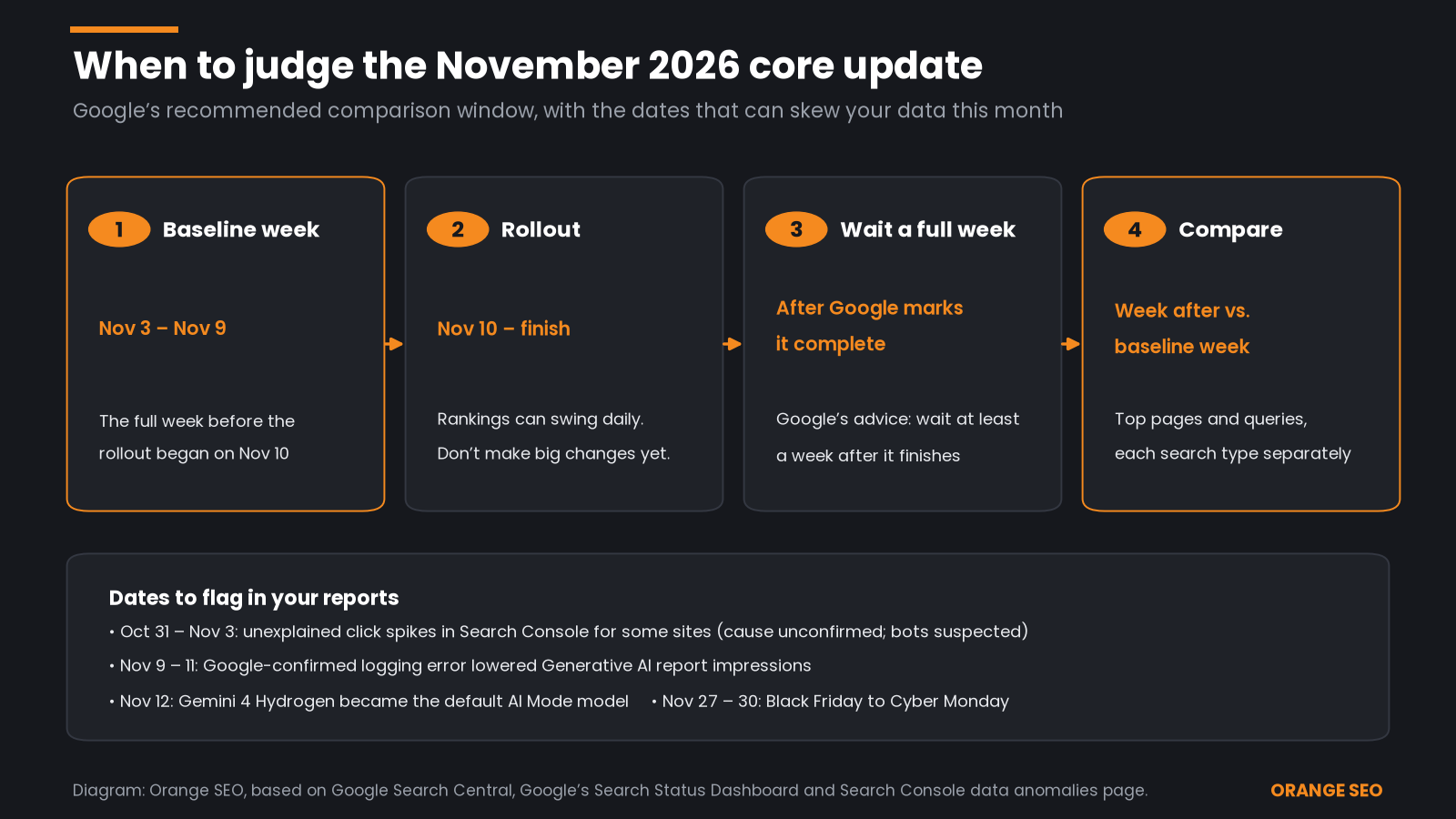
Diagram: Orange SEO, based on Google Search Central
Step 1: Confirm the rollout is finished
Check the Search Status Dashboard and note the official start and end dates. Until the end date appears, any conclusion is premature.
Step 2: Wait a full week, then compare the right weeks
Google recommends waiting at least a full week after the update completes. Then, in Search Console's Performance report, compare that week with the week before the rollout began (November 3 to 9).
Because of the holidays, also compare the same weeks from last year. If traffic is down 20% this year but was also down 20% over the same week last year, that's probably the calendar, not Google.
Step 3: Review your top pages and queries
Sort by clicks and look at the pages and searches that matter most to your business. Ask two questions:
- How far did it move? A slip from position 2 to 4 is very different from a fall from 4 to 29.
- Is it one page or the whole site? A few pages shifting is normal. A drop across most of the site is a bigger signal.
Step 4: Check each search type separately
Look at Web, Image, Video and News results one at a time. A drop in image traffic, for example, calls for a different fix than a drop in regular web results.
Step 5: Track leads, not just traffic
Rankings and clicks only matter if they turn into calls, form fills and sales. Check your lead and conversion data for the same weeks. A small traffic dip with steady leads is rarely an emergency.
What to do if your rankings dropped
Google's guidance matches the size of your response to the size of the drop.
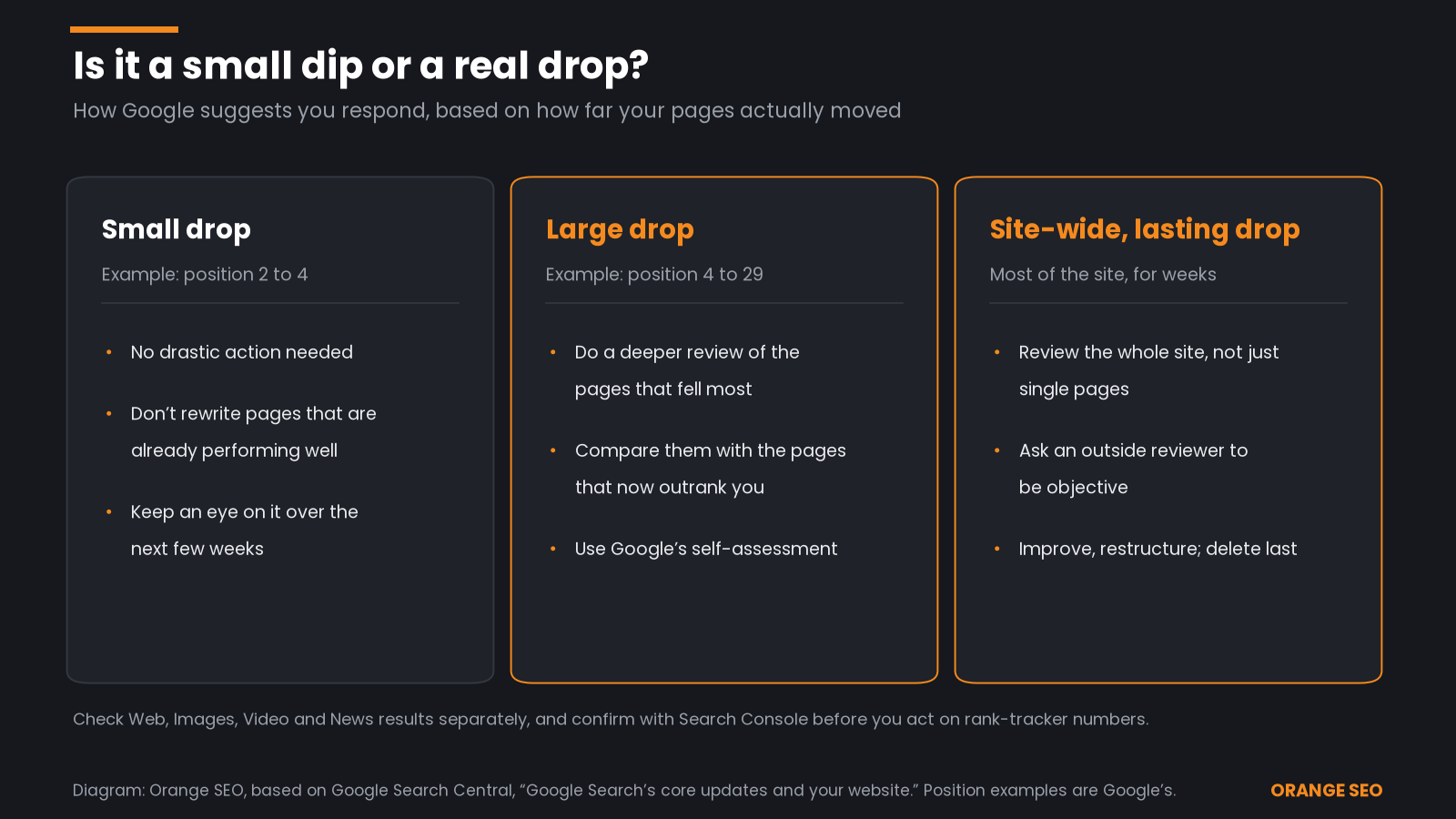
Diagram: Orange SEO, based on Google Search Central
Small drops: hold steady
If a page slipped a few spots, Google specifically advises against changing content that's already performing well. Rankings often wobble during and after an update. Keep watching for a few weeks.
Large drops: compare yourself with the pages that won
Open the searches where you lost the most ground and look at what now ranks above you. Ask honestly:
- Does their page answer the question more completely or more clearly?
- Does it show real experience, such as original photos, examples, pricing or results?
- Is it easier to read and navigate on a phone?
- Is it more current than yours?
Google's self-assessment questions on helpful, reliable, people-first content are the best checklist here. Google also suggests asking someone outside your business to review your site, since it's hard to judge your own pages objectively.

After a large drop, review the pages that fell most against the pages that now outrank them.
Site-wide drops: fix the whole site, not one page
A large, lasting drop across most of your site usually points to the site as a whole, not a single page. Google hasn't said what this update targets, but in our experience common problems include thin service pages, lots of near-duplicate location pages, and content mass-produced with AI and published without expert review. We explain that last risk in Can AI-Generated Content Hurt SEO?
Focus on changes that help real visitors:
- Rewrite or restructure weak pages so they're clearer and more useful. Our on-page SEO and website optimization service starts here.
- Strengthen your most important pages with real expertise, specifics and up-to-date details. That's the focus of our content creation work.
- Delete only as a last resort. Google says removing content should be reserved for pages that can't be saved.
How long recovery takes
Be patient. Google says some improvements can show up within days, but it can take several months for its systems to recognize that a site as a whole has improved. Sometimes the biggest recovery waits for the next core update. Google also runs smaller, unannounced core updates in between, so steady improvements can pay off sooner. There's no guaranteed timeline.
What not to do right now
- Don't make "quick fix" changes, like removing a page element because someone online said it hurts SEO. Google warns against this.
- Don't panic over one rank tracker. Confirm any big move in Search Console first.
- Don't judge AI visibility on November 9 to 11. That's the confirmed reporting gap.
- Don't cut your holiday marketing based on a few days of noisy search data. Paid ads, email and social can carry you while organic search settles.
- Don't forget AI search. Pages that are clear, specific and well-sourced tend to do better in both regular results and AI answers. Our AI SEO and GEO services cover both.
Frequently asked questions
When did the Google November 2026 core update start?
Google's Search Status Dashboard lists the start as November 10, 2026, at 10:06 AM Pacific. It applies globally and to all languages.
When will the November 2026 core update finish?
Google said it may take up to two weeks, which points to around November 24. As of November 23 it was still listed as active, and past core updates have often run longer than two weeks.
How do I know if the core update hurt my site?
Wait at least a week after Google marks the rollout complete. Then compare that week in Search Console with November 3 to 9, review your top pages and queries, and compare against the same weeks last year to rule out holiday seasonality.
Should I change my website during the rollout?
No. Google recommends waiting until the update finishes and avoiding quick fixes. If you see a large, lasting drop afterward, improve your weakest pages in ways that genuinely help visitors.
Did the core update change AI Overviews and AI Mode?
Google hasn't said. Separately, on November 12 Google made Gemini 4 Hydrogen the default model in AI Mode and uses it for the hardest AI Overview questions, so AI visibility changes this month may come from either.
Can I recover from a core update drop?
Yes, but it takes time. Google says it can take several months for its systems to recognize real improvements, and the biggest changes often come with the next core update.
Need help reading your core update data?
Core updates reward websites that genuinely help people, and this one arrives at the busiest time of year. If your traffic moved and you're not sure why, contact Orange SEO. We'll separate update effects from holiday noise and reporting glitches, and build a clear plan to protect and grow your search visibility.
Sources
- Google Search Status Dashboard, "November 2026 core update" (Nov 10, 2026): https://status.search.google.com/incidents/WLxcJyC6jMWMfryxsKMc
- Google Search Status Dashboard, Ranking incident history (core update durations, 2023 to 2026): https://status.search.google.com/products/rGHU1u87FJnkP6W2GwMi/history
- Google Search Central, "Google Search's core updates and your website" (updated Dec 10, 2025): https://developers.google.com/search/docs/appearance/core-updates
- Google Search Central, "Creating helpful, reliable, people-first content": https://developers.google.com/search/docs/fundamentals/creating-helpful-content
- Search Console Help, "Data anomalies in Search Console": https://support.google.com/webmasters/answer/6211453?hl=en
- Google, "Google Search gets a major upgrade with Gemini 4 Hydrogen" (Nov 12, 2026): https://blog.google/products-and-platforms/products/search/gemini-4-hydrogen-search-upgrade/
- Search Engine Journal, "Google Makes Gemini 4 Hydrogen The Default Model In AI Mode" (Nov 12, 2026): https://www.searchenginejournal.com/google-gemini-4-hydrogen-default-ai-mode/597096/
- Search Engine Land, "Google November 2026 core update rolling out now" (Nov 10, 2026): https://searchengineland.com/google-november-2026-core-update-rolling-out-now-501348
- Search Engine Land, "Google Search Console performance report data bug Nov 9-11" (Nov 12, 2026): https://searchengineland.com/google-search-console-performance-report-data-bug-nov-9-11-501899
- Search Engine Roundtable, "Google November 2026 Core Update Ranking Volatility" (Nov 16, 2026): https://www.seroundtable.com/google-november-2026-core-update-ranking-volatility-42543.html
- Search Engine Roundtable, "Google Performance Reports Showing Weird Spike In Clicks For Some Sites" (Nov 3, 2026): https://www.seroundtable.com/google-performance-reports-spike-clicks-42448.html
- Semrush, "Google November 2026 core update: What marketers should know" (Nov 17, 2026): https://www.semrush.com/blog/google-core-update-november-2026/