Why Podcast Advertising Is One of the Best (and Most Underrated) Growth Channels for Your Business
Why Podcast Advertising Is One of the Best (and Most Underrated) Growth Channels for Your Business
If your business already spends money on Google Ads, Meta, or SEO, you’ve probably noticed two things:
Podcast advertising is a rare channel that helps with both. It lets you “borrow” the credibility of hosts people listen to for 30–60 minutes at a time, often every week. And unlike many digital channels, you don’t need a massive budget, a full production team, or months of creative testing to get started.
Podcast ads work because they sit in the sweet spot between performance marketing and brand marketing: they build awareness and consideration quickly, but they can also drive measurable actions (calls, form fills, trial signups, promo-code sales, and branded search lift).
Below is why podcasts are such a strong advertising channel, how the audience breaks down by age, what it typically costs, and how to launch without making it complicated.
Podcasts = high attention + high trust (the two ingredients most ads are missing)
Most ad formats fight for attention in feeds where people are multitasking, scrolling, or actively trying to skip. Podcasts are different:
Long-form attention: People choose a show and commit. That means your message is delivered when listeners are actually tuned in, often during commutes, workouts, chores, and focused work.
Host trust carries over: Many podcast ads are read by the host (or integrated as a personal recommendation). It doesn’t feel like a random banner ad—it feels like a referral.
Repeat exposure is built in: Podcast audiences are habit-driven. If your brand shows up across multiple episodes (or multiple shows), you get the marketing holy grail: repetition without fatigue.
This is especially powerful for businesses that require trust before purchase: home services, professional services, healthcare, B2B, local businesses, SaaS, education, and high-consideration e-commerce.
“Who actually listens to podcasts?” More people than most business owners realize
Podcast consumption has moved from niche to mainstream. In the U.S., a majority of people 12+ consume podcasts monthly, and weekly consumption is also substantial. That matters because weekly listeners are typically the most valuable advertising audience—they have routines and they show up consistently.
Monthly podcast consumption by age group (U.S.)
Ages 12–34: 66% are monthly podcast consumers
Ages 35–54: 61% are monthly podcast consumers
Ages 55+: 38% are monthly podcast consumers
Translation: podcasts aren’t just “a young-person thing.” You can reach Gen Z and Millennials and still get meaningful reach into Gen X and Boomers, depending on show category.
Video podcasts are expanding the opportunity even more
Podcasting isn’t only audio anymore. Video podcast consumption has become a major driver of growth, which opens up extra placements, additional inventory, and more “YouTube-like” discovery benefits.
If your business benefits from demonstrations (fitness, wellness, finance, real estate, legal, education, marketing, product-based brands), video podcast ecosystems can be especially attractive.
Podcast ads aren’t “super expensive” if you buy them the right way
Podcast advertising pricing is typically quoted in CPM (cost per thousand impressions/downloads/views). What you pay depends on:
show size and audience quality
host-read vs produced ad
pre-roll vs mid-roll vs post-roll placement
whether the ad is “baked in” forever or dynamically inserted for a set time
A practical benchmark many buyers use:
Pre-roll tends to be cheaper than mid-roll
Mid-roll usually performs best (highest attention)
Post-roll is cheapest but often lowest response
Here’s the key point: you don’t need to sponsor a top-10 podcast to get results. In fact, many small and mid-sized businesses do better with:
niche shows (tight audience fit)
local/regional shows (geographic relevance)
multiple mid-sized podcasts (diversified testing)
That’s how you keep costs reasonable while still getting meaningful reach and performance.
Podcasts are easy to work with compared to many ad channels
A huge hidden advantage: operational simplicity.
Many podcasts (or podcast networks) will accept:
a short script + talking points, or
a simple brand brief + a product/service trial, or
a host-read outline + disclaimer
You don’t need:
a film crew
20 creative variations
landing pages for every audience segment
constant creative refresh to avoid fatigue
Common ad formats (and what to pick)
1) Host-read (recommended for most SMBs)
Sounds natural and authentic
Strong “trust transfer”
Great for services, local businesses, and higher-consideration offers
2) Produced spot (pre-recorded)
More controlled messaging
Useful for compliance-heavy industries
Easy to reuse across multiple shows
3) Baked-in vs Dynamic insertion
Baked-in: The ad lives in the episode forever (long tail value)
Dynamic: The ad runs for a defined window (more control and fresher offers)
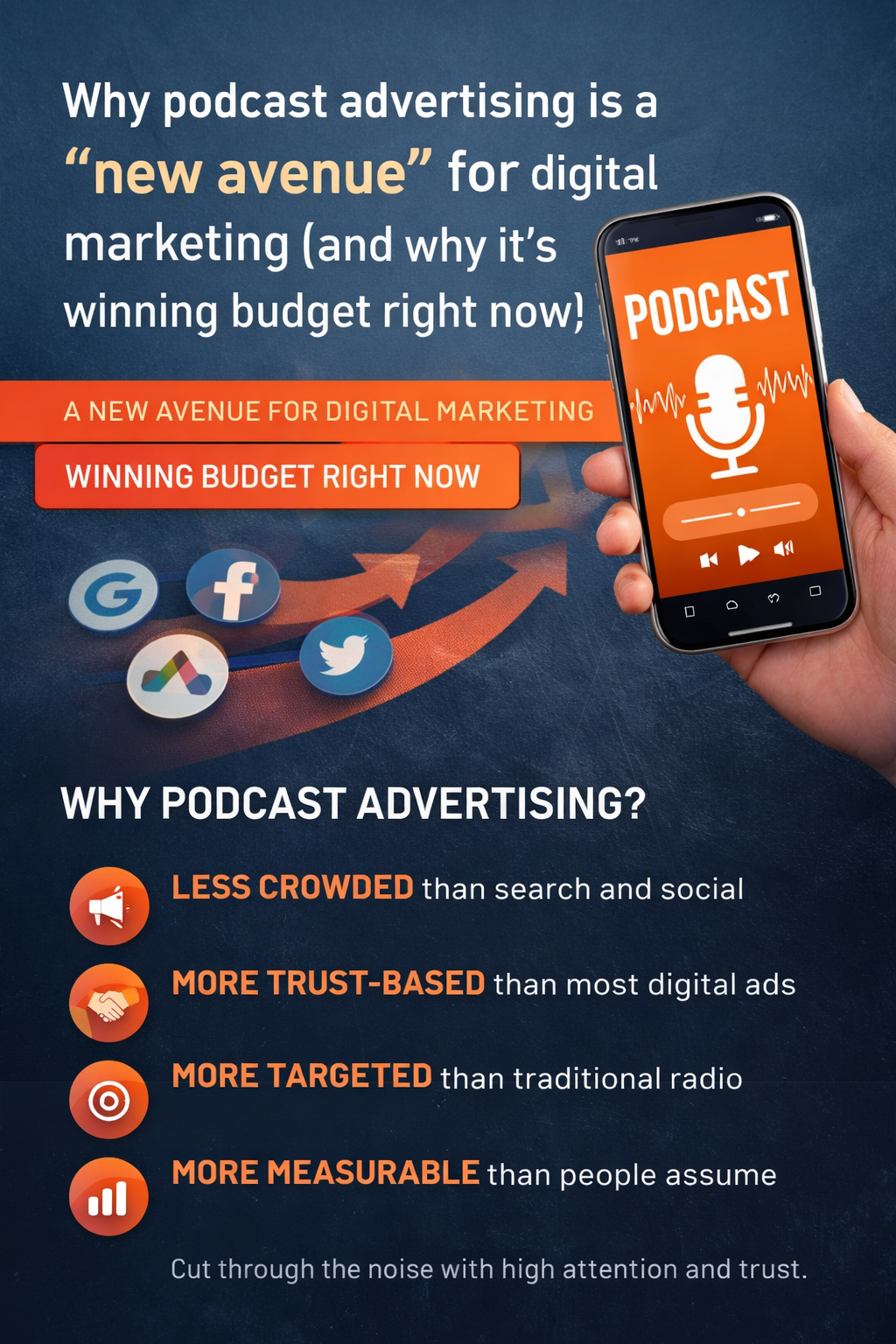
Why podcast advertising is a “new avenue” for digital marketing (and why it’s winning budget right now)
Most businesses are over-allocated to the same handful of channels. That creates competition, rising CPCs, and creative fatigue.
Podcasts offer a different lane:
Less crowded than search and social
More trust-based than most digital ads
More targeted than traditional radio
More measurable than people assume, when you set it up correctly
How you measure podcast ROI (without guessing)
You can track podcasts cleanly using:
unique landing pages (example.com/podcastname)
unique promo codes
call tracking numbers
post-launch branded search lift (often a major indicator)
geo tests (run ads in certain markets and compare lift)
When podcast advertising works, you usually see:
a lift in branded search
higher close rates on inbound leads (“I’ve heard of you” effect)
improved conversion rates across other channels because brand familiarity increases
Podcasts often don’t replace search/social—they make them perform better.
How to get started (simple plan that doesn’t waste money)
If you’re new to podcasts, don’t overcomplicate it:
Pick 3–7 shows where the audience clearly matches your buyers
Run for 4–8 weeks (you need frequency)
Use host-read ads with a clear offer and CTA
Track with a dedicated landing page + call tracking
Evaluate: cost per qualified lead + close rate + branded search lift
Scale winners, cut losers, and expand into adjacent shows
A common mistake is doing one episode on one show and calling it “a test.” Real tests require repetition.
Conclusion: Why Podcasts Deserve a Spot in Your Marketing Mix
Podcast advertising sits at the intersection of attention, trust, and targeting—three variables that directly influence marketing performance. Unlike crowded search and social platforms where users are distracted and skimming, podcasts deliver your message in an environment where audiences are intentionally listening. That difference alone changes how your brand is received.
From a strategic standpoint, podcasts are not just a branding play. When structured correctly—with host-read ads, consistent frequency, clear calls to action, and proper tracking—they can drive measurable leads, lift branded search volume, and improve conversion rates across your other channels. In many cases, they enhance the performance of Google Ads and SEO because audiences are already familiar with your brand before they search.
Financially, podcasts are accessible. You do not need a national brand budget to participate. Niche shows with aligned audiences often outperform large, expensive placements because audience fit drives response. Operationally, they are straightforward: minimal creative lift, collaborative hosts, and clear CPM-based pricing.
If your business relies on trust, credibility, and repeat exposure to move prospects through the buying cycle, podcast advertising is one of the most efficient and underutilized channels available right now.
The opportunity is simple: while competitors fight over the same digital real estate, you can build authority in a space where attention is deeper and relationships are stronger.
Podcast Advertising Is Underrated Video:
FAQ: Podcast Advertising for Businesses
1) What types of businesses do best with podcast ads?
Service businesses, professional services, local/regional brands, healthcare/wellness, B2B, SaaS, education, and e-commerce with clear positioning all tend to do well—especially if trust and credibility matter.
2) Are podcast ads only good for big brands?
No. Many SMBs win by advertising on niche podcasts with highly aligned audiences. Audience fit often beats raw audience size.
3) How much should I budget to start?
Enough to run multiple placements for at least 4 weeks so you can measure impact. A “real test” typically means multiple episodes and/or multiple shows to generate frequency.
4) Should I do host-read or produced ads?
Host-read is usually the best starting point because it leverages trust. Produced spots are helpful if you need strict message control or compliance language.
5) How do I know which podcasts my customers listen to?
Start with industry/category shows, competitor mentions, and “listener overlap” logic (what else your audience consumes). You can also survey customers, check YouTube podcast channels, and review podcast charts by category.
6) Can podcast ads drive immediate leads, or is it only “brand awareness”?
They can do both. With a strong offer and tracking (landing page, promo code, call tracking), podcasts can generate direct response leads. They also typically boost branded search and overall conversion rates.
7) What’s the biggest mistake businesses make with podcast ads?
Running too short, on too few shows, with weak tracking. Frequency + clean attribution is what separates “it didn’t work” from “we didn’t run it correctly.”
8) How can Orange SEO help?
We can build a podcast advertising plan end-to-end: audience targeting, show selection, negotiating placements, scripting and host-read guidance, landing page + tracking setup, and performance reporting—so you can scale what works without wasting spend.
Sources
Edison Research — The Podcast Consumer 2025
https://www.edisonresearch.com/wp-content/uploads/2025/07/The-Podcast-Consumer-2025-revised-FINAL.pdfEdison Research — The Infinite Dial 2025
https://www.edisonresearch.com/wp-content/uploads/2025/03/The-Infinite-Dial-2025-Presentation.pdfIAB — U.S. Podcast Advertising Revenue Study (FY2023, released May 2024)
https://www.iab.com/wp-content/uploads/2024/05/IAB_US_Podcast_Advertising_Revenue_Study_FY2023_May_2024.pdfLibsyn Ads — Podcast Advertising Rates & Benchmarks
https://advertising.libsyn.com/podcast-advertising-ultimate-guide